Everything About 2 Stroke Lawn Mowers: Uses & Maintenance
- The global lawn mowers market reached USD 33.66 billion in 2024 and is projected to grow to USD 48.60 billion by 2030, according to Grand View Research, yet the 2 stroke lawn mower continues to hold a firm and loyal user base despite the rising tide of battery-electric alternatives.
- Whether you manage a compact backyard, a sloped rural property, or rough grass terrain, understanding how a 2 stroke lawn mower works will help you decide if it belongs in your tool shed.
- As emission standards tighten globally, the two-stroke engine is evolving, and knowing where it still excels gives you a clear edge in making smart, cost-effective lawn care decisions.


The 2 stroke lawn mower remains one of the most recognized tools in residential and rural lawn care, even as the global market shifts toward electric alternatives. With the lawn mower market valued at USD 33.66 billion in 2024 (Grand View Research), the segment for gas-powered walk-behind mowers still commands a significant share, particularly in regions where electricity infrastructure is limited or where users prioritize power-to-weight ratio above all else.
The 2 stroke lawn mower earns its place through raw simplicity, light construction, and the kind of cutting torque that handles dense or overgrown grass without complaint. Some users remain loyal to the two-stroke format because of familiarity, affordability, and the absence of complex engine systems. A two-stroke mower has fewer parts than its four-stroke counterpart, which translates directly into lower repair costs and faster field fixes.
What Is 2 Stroke Lawn Mower?
A 2 stroke lawn mower is a grass-cutting machine powered by a two-stroke internal combustion engine, meaning the engine completes one full power cycle intake, compression, combustion, and exhaust in just two piston strokes, or one crankshaft revolution.
This design differs fundamentally from a four-stroke engine, which requires four piston strokes to complete the same cycle. The result is a more compact, lighter power unit that fires with every revolution of the crankshaft.
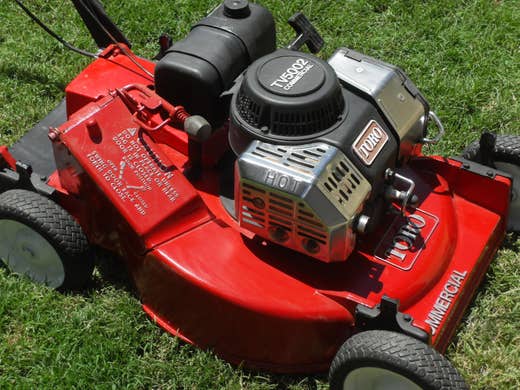
Because the two-stroke engine has no separate oil sump (the reservoir that holds engine oil in a four-stroke unit), it requires the operator to mix oil directly into the fuel before filling the tank. This pre-mixed fuel lubricates the engine internally as it burns, which is why fuel preparation is a critical skill for any two-stroke mower user.
How It Differs from Other Lawn Mower Engines
The core difference between a 2 stroke engine and a 4 stroke engine lies in valve timing and lubrication method. Four-stroke engines use separate intake and exhaust valves controlled by a camshaft, and they circulate oil through a dedicated lubrication system.
Two-stroke engines skip both of these systems — ports in the cylinder wall handle gas flow, and oil mixed into fuel handles lubrication. This removes dozens of components from the design, making the engine significantly lighter and mechanically simpler.
Main Components of 2 Stroke Mower
- Cylinder and piston assembly: The single cylinder houses the piston, which compresses the fuel-air mixture and transfers combustion force to the crankshaft in two strokes rather than four.
- Crankcase and transfer ports: The crankcase acts as a pre-compression chamber, drawing in the fresh fuel-air-oil mixture before it transfers through ports into the combustion chamber above the piston.
- Carburetor: This component meters the air and fuel flowing into the engine and is adjustable for different altitudes and operating conditions.
- Spark plug: Fires once per crankshaft revolution in a two-stroke engine, twice as frequently as in a four-stroke unit, which accelerates spark plug wear over time.
- Recoil starter: A pull-cord mechanism that spins the crankshaft to initiate the first compression stroke and start the engine.
- Cutting deck and blade: A steel housing that contains the rotating blade, directing cut grass either into a collection bag, through a side discharge chute, or back into the lawn as mulch.
How Two Stroke Lawn Mower Works
A 2 stroke lawn mower works by completing its power cycle in just two piston movements, making it simple yet powerful. It mixes fuel and oil together, which is then burned in the engine to produce energy. This design allows the mower to run at high speed with a lightweight structure. Because of its quick power delivery, it is often used for small to medium lawn cutting tasks.
Two-Stroke Combustion Cycle Explained
The two-stroke combustion cycle is elegant in its efficiency. On the first stroke the upstroke the piston moves upward, compressing the fuel-air-oil mixture trapped above it in the cylinder. Simultaneously, the upward movement of the piston creates a partial vacuum in the crankcase below, drawing a fresh charge of fuel-air mixture through the carburetor into the crankcase. When the piston reaches top dead center (TDC), the spark plug fires, igniting the compressed mixture.
On the second stroke the downstroke the expanding combustion gases push the piston downward with force. This downstroke compresses the fresh charge sitting in the crankcase below. As the piston passes the exhaust port on its way down, burned gases escape.

Slightly lower in the cylinder, the transfer ports open, and the pre-compressed fresh charge from the crankcase flows up into the cylinder, pushing out the remaining exhaust gases in a process called scavenging. The cycle then repeats with the next upstroke. One revolution equals one complete power event, which is why two-stroke engines deliver a power pulse with every crankshaft turn.
Fuel and Oil Mixture Process
Because the oil travels through the engine mixed with fuel rather than circulating from a separate sump, the ratio of oil to gasoline must be precise. Too little oil and the engine will run dry on lubrication, causing rapid wear or seizure. Too much oil and the engine will smoke heavily, foul the spark plug, and lose power.
The standard recommendation for most 2 stroke lawn mower engines is a 50:1 ratio 50 parts gasoline to 1 part two-stroke engine oil though some older engines specify 25:1 or 32:1. Always check the manufacturer’s manual for the correct specification.
Power Generation and Blade Operation
The crankshaft converts the piston’s linear (up-and-down) motion into rotational motion. On a 2 stroke lawn mower, the crankshaft connects directly or via a short shaft to the cutting blade mounted beneath the deck. The blade rotates at speeds typically ranging from
2,700 to 3,200 RPM, generating the tip speed needed to cut grass cleanly. The aerodynamic shape of the blade also creates airflow that lifts grass upright before the blade strikes it, improving cut quality on fine turf.History and Evolution of 2 Stroke Garden Mowers
2 stroke garden mowers were developed as a simple and lightweight alternative to early bulky lawn cutting machines. They became popular because of their easy engine design, quick power output, and lower manufacturing cost. Over time, improvements in fuel efficiency and engine performance made them more reliable for regular garden use. Today, they are still valued for their portability and strong cutting ability in small to medium areas.
Early Development
The two-stroke engine predates the lawn mower by several decades. Scottish engineer Dugald Clerk patented the first practical two-stroke cycle engine in 1881. When gasoline-powered lawn mowers began replacing reel mowers in the 1930s and 1940s, the two-stroke engine was a natural fit — it was compact, affordable to manufacture, and could be oriented in different positions without disrupting lubrication, unlike early four-stroke designs that required a level crankcase to maintain oil coverage.
Popularity in Residential Lawn Care
Through the 1950s, 1960s, and 1970s, two-stroke walk-behind mowers dominated the residential market in the United States, Australia, and parts of Europe. Their light weight made them easy for homeowners to push across suburban lawns, and their inexpensive manufacturing cost kept retail prices accessible. Brands like Victa in Australia built entire product lines around the two-stroke platform, and many of those mowers remained in active use for 20 to 30 years with basic maintenance.
Modern Alternatives and Current Market Position
By the 1990s, four-stroke engines became more competitive in weight and price, prompting many manufacturers to transition their mower lineups. Emission regulations in California and later across the European Union accelerated this shift, as two-stroke engines produce higher hydrocarbon and particulate emissions per unit of fuel burned compared to four-stroke designs.
Today, the two-stroke mower occupies a focused market niche — light-duty residential use, rural properties, developing markets, and budget-conscious buyers who value simplicity and low acquisition cost above fuel economy or emission compliance.
Key Features of 2 Stroke Lawn Mower
2 stroke lawn mowers are known for their simple engine design that delivers quick and powerful performance. They are lightweight and easy to carry, making them suitable for small gardens and tight spaces. These mowers use a fuel and oil mixture, which helps keep the engine running efficiently. Their high-speed operation ensures fast grass cutting with less effort from the user.
Lightweight Construction
A typical 2 stroke push mower weighs between 18 and 28 kilograms, noticeably lighter than equivalent four-stroke models which can exceed 35 kilograms. This weight difference matters on sloped terrain and during extended mowing sessions, where operator fatigue directly impacts cutting consistency and safety.
Simple Engine Design
The absence of a camshaft, rocker arms, oil pump, and separate valve train means there are roughly 30 to 40 percent fewer moving parts in a two-stroke engine compared to a four-stroke unit of equivalent displacement. Fewer parts means fewer potential failure points, which is why two-stroke mowers remain popular in remote areas where specialist mechanics are not readily available.
High Power-to-Weight Ratio
Two-stroke engines produce one power stroke per crankshaft revolution, while four-stroke engines produce one power stroke every two revolutions. This fundamental difference gives two-stroke engines a higher power-to-weight ratio — more horsepower per kilogram of engine mass which is why they power chainsaws, brush cutters, and outboard motors where compact power is essential.
Fewer Moving Parts
With no camshaft, no timing chain, no separate oil pump, and no oil filter to replace, routine maintenance on a 2 stroke mower is genuinely straightforward. The core maintenance tasks reduce to checking the spark plug, cleaning the air filter, and ensuring the fuel mixture is correct tasks any attentive homeowner can handle without special tools.
Easy Starting System
Most 2 stroke lawn mowers use a recoil pull-start system. Because the engine fires on every crankshaft revolution rather than every other revolution, the compression ratio required to start the engine is lower than in a four-stroke unit, which often means a two-stroke engine starts in fewer pulls when the choke and primer bulb are used correctly.
Benefits of Using 2 Stroke Garden Mower
A 2 stroke lawn mower offers several benefits, especially for small and medium garden maintenance tasks. It is lightweight and easy to handle, which makes it suitable for users who prefer simple operation without heavy equipment.
The engine delivers quick and powerful performance, allowing fast grass cutting with less effort. It is also generally more affordable than other mower types, making it a cost-effective option for home gardeners.
i. Strong cutting power relative to size: The high power-to-weight ratio means a compact two-stroke engine delivers sufficient torque to handle thick or wet grass that would bog down an underpowered four-stroke unit of similar physical dimensions.
ii. Lightweight and easy to handle: For elderly users, smaller adults, or anyone mowing on steep slopes, the reduced mass of a two-stroke mower translates into less fatigue and greater control during extended sessions.
iii. Lower initial purchase cost: Two-stroke mowers consistently retail at 15 to 30 percent less than comparable four-stroke models, making them the entry point for budget-conscious homeowners entering the gas mower market.
iv. Simple maintenance requirements: Without an engine oil change schedule, valve adjustments, or timing belt inspections, the maintenance burden of a 2 stroke mower is genuinely minimal compared to four-stroke alternatives.
v. Suitable for uneven and rough terrain: Unlike ride-on mowers or heavy self-propelled units, a light two-stroke push mower navigates around obstacles, up embankments, and across irregular ground contours with minimal effort.
Types of two Stroke Lawn Mowers
2 stroke lawn mowers come in different types based on their design and usage needs. Handheld brush cutter-style mowers are common for trimming grass in hard-to-reach areas and edges. Push-type 2 stroke mowers are used for small lawns where more control and stability are needed. There are also wheeled models that offer better balance and smoother cutting on slightly larger garden spaces.
A. Push 2 Stroke Lawn Mowers
The push two-stroke mower is the most common format. The operator walks behind the machine, providing forward momentum manually while the engine powers only the cutting blade. These models are ideal for flat or gently sloped lawns up to around 500 square meters. Their light weight and simple design keep purchase prices low and maintenance tasks manageable.
B. Self-Propelled 2 Stroke Lawn Mowers
Self-propelled two-stroke mowers add a drive system — typically a friction wheel or gearbox linked to the rear wheels — that pulls the machine forward without the operator needing to push. This design is suited to larger lawns, sloped ground, or users who find sustained pushing physically demanding. The added drive system increases weight and complexity slightly but significantly reduces operator effort over long mowing sessions.
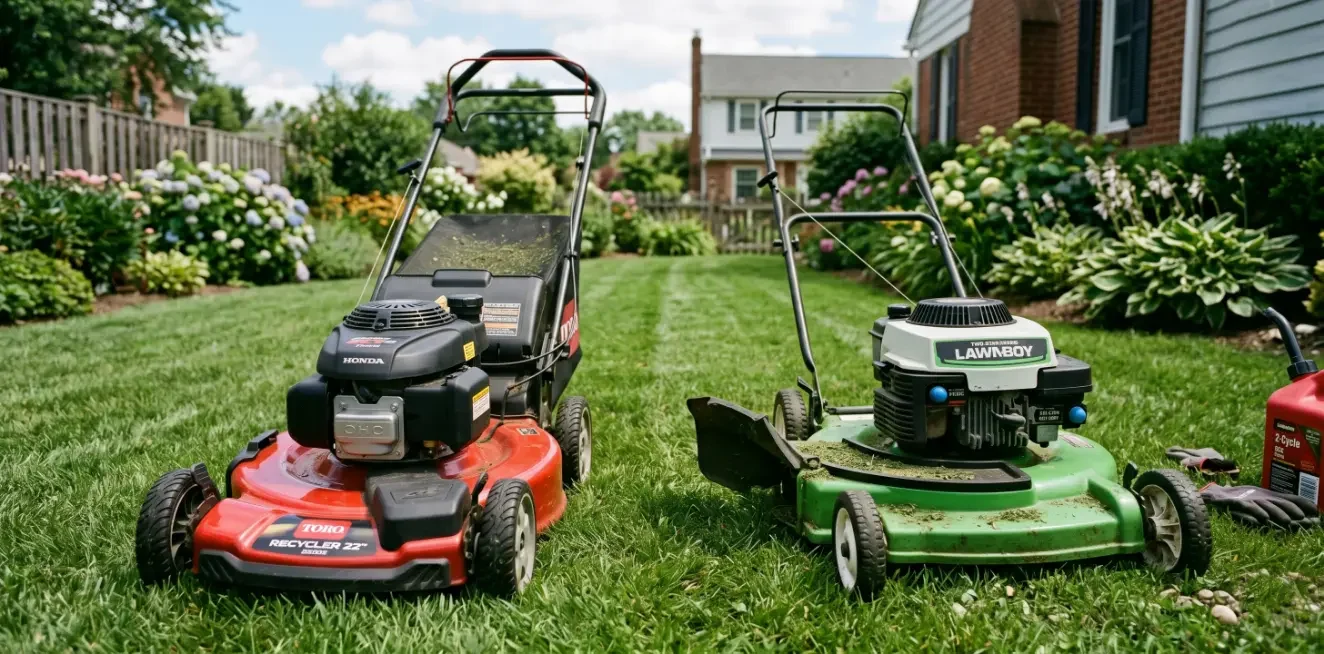
C. Commercial 2 Stroke Lawn Mowers
Commercial two-stroke mowers use heavier-gauge decks, wider cutting widths (commonly 46 to 53 centimeters), and higher-output engines designed for daily use across multiple properties. Professional landscapers in price-sensitive markets still deploy two-stroke commercial mowers where budget and fuel simplicity outweigh the emission and fuel-efficiency advantages of four-stroke alternatives.
D. Brush Cutter Style 2 Stroke Mowers
Brush cutter-style two-stroke mowers blur the line between a traditional wheeled mower and a handheld brush cutter. They use a wheeled frame and wide cutting blade similar to a standard mower, but the operator often holds and guides the machine by two handles mounted at hip height. These tools excel in rough scrubland, roadside verges, orchard floors, and any area where a conventional mower’s deck clearance is insufficient for tall, woody vegetation.
2 Stroke Lawn Mower vs 4 Stroke Lawn Mower
2 stroke lawn mowers are lighter, simpler in design, and deliver power in every crank cycle, making them faster for quick cutting jobs. However, they require a fuel and oil mixture and tend to produce more noise and emissions.
In contrast, 4 stroke lawn mowers are more fuel-efficient, quieter, and environmentally friendly, as they use separate oil and fuel systems. While 2 stroke models are better for portability and small tasks, 4 stroke mowers are preferred for larger lawns and long-term use.
1. Engine Design Differences
The two-stroke engine completes its power cycle in one crankshaft revolution; the four-stroke requires two. This fundamental mechanical difference drives most of the practical distinctions between the two types.
Four-stroke engines have separate intake and exhaust valves, a camshaft to drive them, and a dedicated lubrication system that keeps oil separate from fuel. Two-stroke engines use cylinder-wall ports for gas flow and rely on oil mixed into fuel for lubrication — a simpler but less thermally efficient approach.
2. Fuel Requirements
Four-stroke lawn mowers run on straight unleaded gasoline, exactly the same fuel used in passenger cars. Two-stroke mowers require a pre-mixed fuel consisting of gasoline and two-stroke engine oil at a specified ratio. This additional preparation step is a minor inconvenience for careful users but becomes a meaningful problem if the wrong mixture is used accidentally.
3. Performance Comparison
For equivalent engine displacement, a two-stroke engine typically produces more raw power but burns fuel faster and less efficiently. A four-stroke engine of the same size delivers lower peak power but better fuel economy, smoother running, and fewer emissions. In practical lawn mowing terms, this means a two-stroke mower tackles dense, wet, or overgrown grass with slightly more aggression, while a four-stroke mower runs more quietly and economically during routine cutting of maintained turf.
4. Maintenance Comparison
Four-stroke engines require periodic oil changes typically every 25 to 50 hours of operation or once per season in addition to the same air filter and spark plug maintenance required by two-stroke engines.
Two-stroke engines skip the oil change entirely, since oil is consumed with each tank of fuel. However, two-stroke spark plugs foul faster due to the oily combustion mixture, making spark plug inspection a more frequent task.
5. Cost Comparison
At point of purchase, two-stroke mowers cost less. Over a five-year ownership period, the cost advantage narrows as fuel costs (two-stroke fuel mix is slightly more expensive to prepare than straight gasoline) and faster spark plug replacement add up.
Four-stroke mowers incur oil change costs but deliver better fuel economy, so the total cost of ownership difference over five years is often less than USD 80 to 120 in favor of the two-stroke model, depending on usage frequency.
Which Is Better for Different Users?
Choose a two-stroke mower if you prioritize low purchase price, light weight, simple mechanics, and you are comfortable preparing fuel mixtures accurately. Choose a four-stroke mower if you want quieter operation, better fuel economy, lower emissions, and you prefer the convenience of straight gasoline without mixing.
The best lawn mower is not the one with the most features it is the one that starts reliably every time, handles the grass you actually have, and stays within a maintenance routine you will honestly follow.
Common Uses of 2 Stroke Lawn Mower
The two-stroke mower fits comfortably across a range of applications. Understanding where it performs best helps you set realistic expectations before purchasing.
- Small residential lawns (up to 300 square meters): A push two-stroke mower handles compact suburban lawns quickly and efficiently, and its light weight makes storage and transport straightforward.
- Medium-sized yards (300 to 700 square meters): A self-propelled two-stroke model covers medium yards without excessive operator fatigue, particularly where terrain is irregular.
- Rough grass areas: The high-torque output of a two-stroke engine at lower RPM handles coarse, tufted grass that standard residential mowers struggle with.
- Sloped landscapes: The light weight of a two-stroke push mower is a genuine safety advantage on slopes, where a heavier machine becomes harder to control and increases the risk of slipping.
- Rural properties: Remote locations with limited access to service centers benefit from the mechanical simplicity of two-stroke engines, where basic repairs are accessible without specialist training.
Fuel Requirements for 2 Stroke Mower
A 2 stroke lawn mower requires a mixed fuel of petrol and 2-stroke engine oil to operate properly. The oil is blended with fuel in a specific ratio, usually mentioned by the manufacturer, to ensure smooth engine lubrication. This mixture burns inside the engine during operation, helping both power generation and cooling. Using the correct fuel ratio is important for performance, engine life, and reducing smoke.
1. Understanding Fuel-Oil Mixtures
The fuel-oil mixture is the single most important operational variable in two-stroke engine management. The oil suspended in the gasoline lubricates the piston, crankshaft bearings, and connecting rod as the fuel passes through the engine. Without this lubrication, metal surfaces that touch during engine operation generate heat and friction rapidly, leading to accelerated wear or catastrophic seizure within minutes of running on straight gasoline.
2. Recommended Fuel Types
Use unleaded gasoline with a minimum octane rating of 87 RON (Research Octane Number) for most two-stroke lawn mower engines. Avoid ethanol-blended fuels above 10 percent ethanol (E10), as higher ethanol concentrations absorb atmospheric moisture, corrode carburetor components, and degrade rubber fuel lines and seals. If ethanol-free gasoline is available in your area, it is the preferred option for two-stroke engines.
3. Mixing Ratios Explained
Prepare your two-stroke fuel mix using this step-by-step process to ensure accuracy:
- Check your mower’s owner manual to confirm the correct mixing ratio — commonly 50:1, 40:1, or 32:1.
- Start with a clean, approved fuel container rated for gasoline storage — never use a container previously used for other chemicals.
- Pour the two-stroke engine oil into the container first, then add the correct volume of gasoline. Pouring oil first reduces the chance of a pure-gasoline splash before mixing occurs.
- Cap the container and shake firmly for 15 to 20 seconds to ensure the oil and gasoline are fully blended before fueling the mower.
- Label the container with the mixing ratio and the date of preparation, as pre-mixed fuel degrades in quality after 30 days due to oxidation.
4. Fuel Storage Tips
Store pre-mixed two-stroke fuel in a cool, dark location away from direct sunlight and heat sources. Add a fuel stabilizer if you plan to store the mixture for more than two weeks. Never store fuel in the mower’s tank for extended periods drain the tank and run the carburetor dry before placing the mower in off-season storage to prevent gumming and varnish deposits inside the carburetor circuits.
Choosing the Right One Mover
Choosing the right 2 stroke lawn mower depends on your lawn size, grass type, and how often you plan to use it. A good mower should offer a balance of power, weight, and ease of handling for comfortable operation. You should also consider engine capacity, fuel efficiency, and build quality before making a decision. Selecting the right model ensures better performance and long-term durability with less maintenance effort.
i. Lawn Size Considerations
Match the cutting width to the size of your lawn. A 40 to 43 centimeter cutting width suits lawns up to 400 square meters. Wider decks of 46 to 53 centimeters reduce the number of passes needed on larger lawns but add weight and reduce maneuverability around tight garden beds.
ii. Engine Power Requirements
Engine displacement is typically expressed in cubic centimeters (cc). For light residential use, a 35 to 45cc two-stroke engine provides sufficient power. For medium lawns with coarser grass, look for engines in the 50 to 65cc range. Commercial or rough-terrain applications benefit from 70cc and above.
iii. Cutting Width
Wider cutting widths complete jobs faster but can be harder to push in a straight line on uneven ground. Narrower decks are more maneuverable but require more passes to cover the same area. Match the deck width to both your lawn size and your physical comfort with the machine’s overall weight.
iv. Weight and Maneuverability
Test the machine’s weight before purchase if possible. A mower that feels acceptable in a showroom becomes a strain after 30 minutes of continuous use on a warm day. For slopes or irregular terrain, prioritize lower weight even at the expense of cutting width.
v. Build Quality
Inspect the cutting deck material — steel decks offer durability and resistance to impact damage, while polymer (plastic) decks reduce weight and resist corrosion but may crack under repeated stone strikes. Check that the handle height adjustment is firm and does not wobble, and that the blade engagement mechanism operates cleanly without excessive play.
vi. Budget Considerations
Entry-level 2 stroke push mowers retail between USD 100 and USD 200. Mid-range self-propelled models fall between USD 200 and USD 350. Commercial-grade two-stroke mowers can reach USD 500 to USD 700. Factor in the ongoing cost of two-stroke engine oil and replacement spark plugs, which adds approximately USD 20 to USD 40 per season for a typical residential user.
Features to Consider Before Buying
Beyond the core specifications, several secondary features determine how pleasant a 2 stroke mower is to use across a season.
- Adjustable cutting height: Look for at least four height positions, ideally six, ranging from approximately 25 millimeters to 75 millimeters. Single-lever height adjustment that changes all four wheels simultaneously saves time and reduces frustration.
- Grass collection bag: A fabric or plastic collection bag captures clippings for composting or disposal. Bag capacity between 35 and 50 liters suits most residential lawns without requiring frequent emptying.
- Mulching capability: A mulching blade chops clippings finely and returns them to the lawn as a slow-release nitrogen source. Research from the University of Minnesota Extension (2023) found that mulched clippings can return up to 25 percent of the lawn’s annual nitrogen requirement back into the soil without causing thatch buildup when the lawn is mowed at correct frequency.
- Side discharge option: Useful for rough or overgrown grass where volume overwhelms the collection bag — the side discharge chute ejects clippings to the side of the mowing path.
- Foldable handles: Folding handles reduce the storage footprint significantly, which matters in compact garages and garden sheds.
- Wheel design: Larger rear wheels (20 to 25 centimeters diameter) roll more smoothly over uneven ground and require less pushing effort than smaller wheels on rough terrain.
How to Start 2 Stroke Lawn Mower Properly
To start a 2 stroke lawn mower properly, first ensure the fuel tank has the correct petrol and oil mixture as recommended by the manufacturer. Place the mower on a flat surface and switch the ignition to the “ON” position.
If it has a choke, set it to the closed position for a cold start, then pull the starter cord firmly until the engine begins to run. Once started, gradually adjust the choke to keep the engine running smoothly.
Pre-Start Checks
Before every start, confirm that the fuel tank contains fresh, correctly mixed two-stroke fuel. Check that the oil cap is secure. Inspect the blade visually for cracks, bends, or missing sections a damaged blade creates dangerous imbalance. Confirm no stones, sticks, or debris sit directly beneath the cutting deck that could become projectiles on startup.
Priming and Choke Usage
Press the primer bulb — a small rubber or plastic button that pushes a shot of fuel directly into the carburetor — three to five times until you see fuel moving through the clear primer bulb body. Set the choke lever to the closed (full choke) position for a cold start. The choke restricts airflow into the carburetor, creating a richer fuel-air mixture that a cold engine needs to fire initially.
Safe Starting Procedure
- Place the mower on flat, stable ground with the blade zone clear of bystanders and objects.
- Engage any blade brake lever as required by your model’s design — some models require you to hold a bail handle before pulling the starter cord.
- Pull the starter cord firmly and smoothly — not a jerking yank, but a strong, steady pull through the full extension of the cord.
- Once the engine fires briefly (sputters), move the choke to half-open or fully open and pull again to achieve sustained running.
- Allow the engine to idle and warm for 30 to 60 seconds before engaging the blade and beginning to mow.
Common Starting Mistakes
Flooding the engine by over-priming is the most frequent starting error. If the engine floods, remove the spark plug, pull the starter cord six to eight times with the spark plug out to clear excess fuel from the cylinder, replace the plug, and restart with no primer or choke.
Pulling the starter cord while the choke is in the wrong position for engine temperature (cold engine with choke open, or warm engine with choke closed) also causes repeated failed starts and unnecessary wear on the recoil mechanism.
2 Stroke Lawn Mower Maintenance Guide
Regular maintenance of a 2 stroke lawn mower is important to keep it running smoothly and extend its lifespan. Always use the correct fuel and oil mixture to prevent engine damage and reduce smoke. Clean the air filter and cutting blade regularly to maintain proper performance and clean cutting results. After each use, remove grass clippings and store the mower in a dry place to avoid rust and wear.
a. Cleaning After Use
After every mowing session, tilt the mower on its side always with the carburetor side facing up to prevent fuel from entering the air filter and scrape accumulated grass clippings from the underside of the deck with a wooden scraper or stiff brush. Built-up clippings trap moisture against metal surfaces, accelerating corrosion and reducing airflow within the deck, which worsens cut quality.
b. Air Filter Maintenance
A foam or paper air filter clogged with dust and debris forces the engine to run rich (too much fuel relative to air), causing black smoke, power loss, and increased carbon deposit formation inside the cylinder. Inspect the air filter every 10 hours of operation. Clean foam filters by washing in warm soapy water, rinsing thoroughly, allowing to dry completely, and re-oiling lightly with clean engine oil before reinstalling. Replace paper filters rather than washing them.

c. Spark Plug Inspection
Remove and inspect the spark plug every 25 hours of operation. A healthy spark plug shows a tan or light gray electrode with clean gap clearance — typically 0.6 to 0.7 millimeters for most two-stroke small engines. A black, sooty electrode indicates a rich mixture or excessive oil in the fuel mix. A white or blistered electrode signals a lean mixture or ignition timing issue. Replace the spark plug annually regardless of visual condition, as electrode wear affects starting reliability.
d. Blade Sharpening
A sharp blade slices grass cleanly, leaving a crisp cut edge that heals quickly and resists disease entry. A dull blade tears and bruises grass tissue, creating ragged brown tips that weaken turf over time.
Sharpen the blade every 20 to 25 hours of mowing using a bench grinder or hand file, maintaining the original bevel angle (typically 30 degrees) along the cutting edge. After sharpening, balance the blade on a blade balancer or nail before reinstalling to prevent vibration that damages crankshaft bearings.
e. Fuel System Care
At the end of each mowing season, drain the fuel tank completely and run the engine until it stops naturally from fuel starvation. This clears the carburetor circuits and float bowl of residual fuel that would otherwise oxidize over winter storage, forming varnish deposits that block the tiny jets and passages inside the carburetor.
Seasonal Maintenance Checklist
- Replace the spark plug at the start of each new season.
- Clean or replace the air filter before the first mow of spring.
- Sharpen and balance the cutting blade.
- Inspect all fuel lines and primer bulb for cracks, hardening, or fuel seepage.
- Check all fasteners — particularly the blade bolt — and torque to the manufacturer’s specification.
- Lubricate the wheel axles and height-adjustment pivot points with a light machine oil.
- Test start the engine and adjust the carburetor idle speed if the engine hunts or surges at idle.
Common Problems and Troubleshooting
2 stroke lawn mowers can develop a few common issues, but most are easy to fix with basic troubleshooting. If the engine does not start, check the fuel mixture, spark plug condition, and choke setting. Poor performance or loss of power is often caused by a clogged air filter or old fuel. Excess smoke usually indicates too much oil in the fuel mixture, while uneven cutting may be due to a dull or dirty blade. Regular cleaning and proper fuel use can prevent most of these problems.
i. Engine Won’t Start
Check fuel freshness first — stale two-stroke mix older than 30 days is the most common cause of hard starting in mowers that have sat unused. Inspect the spark plug for fouling or a damaged electrode. Confirm the primer bulb is moving fuel (you can see it through the clear bulb body). If all of these check out, remove and clean the carburetor, paying particular attention to the main jet orifice.
ii. Excessive Smoke
Blue or white smoke on startup that clears after a minute of running is normal — this is condensation burning off the exhaust. Persistent heavy blue-white smoke throughout mowing indicates too much oil in the fuel mix, or an air filter so clogged that the engine runs excessively rich. Recalculate and prepare a fresh fuel batch at the correct ratio and replace the air filter if fouled.
iii. Loss of Power
Sudden power loss during mowing most commonly results from a partially blocked air filter, a fouled spark plug, or a carburetor main jet partially obstructed by fuel varnish. Work through these in order — air filter first, then spark plug, then carburetor cleaning — before investigating more complex causes such as worn piston rings or cylinder scoring.
iv. Rough Running Engine
An engine that surges, hunts at idle, or feels erratic typically has a lean fuel condition caused by an air leak at the carburetor gasket or an idle fuel circuit partially blocked by debris. Carburetor cleaning with a purpose-made spray cleaner resolves most cases. If the problem persists after cleaning, inspect the carburetor mounting gasket and the crankcase seals for air leakage.
v. Fuel Mixture Issues
The most preventable two-stroke problem is incorrect fuel mixture. Keep a dedicated mixing container clearly labeled with your engine’s required ratio. Prepare fuel in batches no larger than you will use within two weeks. Never guess at a mixture ratio — use a measuring syringe or graduated mixing bottle to ensure accuracy every time.
Safety Tips for Operating
Wear sturdy, closed-toe footwear never sandals or bare feet when operating any lawn mower. Safety glasses protect against grass clippings, stones, and small debris ejected at speed by the blade. On noisy two-stroke engines running at high RPM, hearing protection is advisable for mowing sessions longer than 30 minutes, as prolonged exposure to engine noise above 85 decibels causes cumulative hearing damage.
i. Safe Fueling Practices
Always fuel the mower outdoors or in a well-ventilated space, away from ignition sources. Never add fuel to a hot engine — allow at least two minutes of cool-down after stopping before opening the fuel cap, as fuel vapor from a warm tank can ignite on hot engine surfaces. Clean up any fuel spillage before starting the engine.
ii. Mowing on Slopes
Mow across slopes rather than up and down them with a walk-behind mower. Moving horizontally across a slope keeps the machine stable and prevents it from rolling back into the operator if traction is lost. Never mow a slope steeper than 30 degrees with a push mower — beyond this angle, loss of control becomes a serious risk.
iii. Blade Safety Precautions
The cutting blade stops within 3 seconds of releasing the blade bail handle on machines equipped with a blade brake clutch (BBC) system. Never reach under the deck while the engine is running. Before clearing blockages, removing the grass bag, or adjusting cutting height, disengage the blade and allow it to stop completely, then disconnect the spark plug lead for absolute safety before working near the blade.
iv. Storage Safety
Store the mower in a dry, ventilated space away from water heaters, electrical panels, and open flames. Fuel stored in the tank is a fire hazard — drain the tank for storage periods exceeding two weeks. Keep the mower out of reach of children, and never store it in a living space where fuel vapors can accumulate.
Environmental Impact of 2 Stroke Lawn Mowers
2 stroke lawn mowers have a noticeable environmental impact because they burn a fuel and oil mixture, which produces higher emissions compared to newer engine types. This results in more smoke, carbon emissions, and air pollutants during operation. They are generally less fuel-efficient, which can increase overall fuel consumption over time. However, modern improved 2 stroke engines have reduced some emissions, but they are still less eco-friendly than 4 stroke or electric alternatives.
a. Fuel Consumption
A typical residential two-stroke mower consumes approximately 0.35 to 0.55 liters of fuel mixture per hour of operation. Over a standard mowing season of 40 hours, this amounts to roughly 14 to 22 liters of fuel per machine annually — a modest figure for an individual household but significant in aggregate across millions of machines globally.
b. Emissions Considerations
Two-stroke engines emit higher levels of unburned hydrocarbons and particulate matter compared to four-stroke gasoline engines and battery-electric alternatives. The California Air Resources Board (CARB) estimates that a single hour of two-stroke small engine operation produces hydrocarbon emissions comparable to driving a modern passenger car for approximately 100 to 300 kilometers, depending on engine condition and mixture ratio accuracy.
c. Noise Levels
Two-stroke mowers typically operate between 88 and 96 decibels at the operator’s ear position, slightly louder than most four-stroke residential mowers and significantly louder than battery-electric alternatives. Many municipalities have noise ordinances restricting powered garden equipment use during early morning and evening hours, which applies equally to two-stroke mowers.
d. Eco-Friendly Operating Practices
To reduce the environmental footprint of a two-stroke mower, use an accurate fuel mixture (correct ratio minimizes unburned hydrocarbon output), keep the air filter clean (a restricted filter forces rich running, increasing emissions), maintain a sharp blade (a sharp blade requires less engine load and less fuel), and consider mulching clippings back into the lawn to reduce the need for synthetic nitrogen fertilizers.
Are 2 Stroke Lawn Mowers Still Worth Buying?
2 stroke lawn mowers are still worth buying for users who need a lightweight, affordable, and easy-to-handle machine for small to medium garden work. They offer strong cutting power and quick engine response, making them useful for trimming grass and working in tight spaces.
However, they require regular maintenance and produce more noise and emissions compared to newer models. If portability and simple operation are your priority, they remain a practical choice, but for larger lawns or eco-friendly use, other options may be better.
1. Advantages in Today’s Market
The 2 stroke lawn mower retains genuine relevance in 2026 despite the rapid growth of battery-electric alternatives. Its lower purchase price, lighter weight, and mechanical simplicity give it a durable advantage in developing markets, rural settings, and among users who mow infrequently and want a machine that starts after months of storage with minimal fuss.
2. Situations Where They Excel
Two-stroke mowers perform best on rough, uneven, or overgrown grass where their torque delivery handles variable resistance better than a battery mower with a fixed power curve. They are also the tool of choice where replacement batteries for electric alternatives are unavailable, unaffordable, or impractical to charge due to unreliable electricity supply.
3. Potential Drawbacks
Emission regulations in California, the European Union, and several Australian states are progressively restricting the sale of new two-stroke residential equipment. Fuel mixture preparation adds a preparation step that battery-electric users never face. Noise output is higher than electric alternatives, which matters in dense residential neighborhoods with strict quiet-hour bylaws.
Who Should Choose a 2 Stroke Mower?
A two-stroke mower suits the homeowner or gardener who values low initial cost, wants a lightweight machine for slopes or rough terrain, is comfortable with basic engine maintenance, and operates in a region where emission regulations have not yet phased out this category.
For urban users in regulated markets, or anyone who mows frequently and values operational simplicity above all else, a four-stroke or battery-electric mower is the stronger long-term investment.
Conclusion
The 2 stroke lawn mower is not a relic it is a focused tool with a defined role in the modern lawn care toolkit. Its mechanical simplicity, lightweight build, and strong power-to-weight ratio make it a compelling choice for specific users and specific environments: rough terrain, sloped properties, budget-conscious buyers, and rural locations where service infrastructure is limited.
Understanding the two-stroke combustion cycle, the importance of a correct fuel-oil mixture, and the straightforward maintenance routine this engine demands puts you in control of a machine that can deliver reliable service for decades when treated correctly.
Frequently Asked Questions (FAQs)
Do 2 Stroke Lawn Mowers Need Mixed Fuel?
Yes. Two-stroke engines require fuel mixed with two-stroke engine oil at the ratio specified in the owner’s manual (commonly 50:1). Running a two-stroke engine on straight gasoline will destroy the engine within minutes due to the absence of internal lubrication.
How Long Does a 2 Stroke Mower Engine Last?
A well-maintained two-stroke mower engine typically lasts between 500 and 1,000 hours of operation before requiring major internal work. At a residential use rate of 40 hours per season, this equates to 12 to 25 years of service life — provided the fuel mixture is consistently correct and routine maintenance is performed on schedule.
Are 2 Stroke Lawn Mowers More Powerful?
Compared to a four-stroke engine of identical displacement, a two-stroke engine produces more power because it fires every crankshaft revolution rather than every other revolution. However, modern four-stroke engines at larger displacements easily match or exceed the absolute power output of smaller two-stroke units, so the power advantage depends on the specific comparison being made.
Why Do 2 Stroke Engines Produce Smoke?
Two-stroke engines burn a mixture of gasoline and oil, so some level of light blue-white exhaust smoke is normal, particularly during warm-up. Excessive smoke indicates too much oil in the fuel mixture, a clogged air filter causing rich running, or worn piston rings that allow oil to enter the combustion chamber from the crankcase.
Can I Use Regular Gasoline in a 2 Stroke Mower?
No. Regular (straight) gasoline without two-stroke oil mixed in will cause rapid and irreversible engine damage. The oil in the fuel mixture lubricates all internal moving parts. Without it, the engine seizes within minutes. Always prepare the correct fuel-oil mixture before filling the tank.
power terms end