Best 4 Stroke Lawn Mower For 2026: Features & Tips
- The global lawn mower market reached a valuation of $8.9 billion in 2024 and is projected to grow at a CAGR of 5.3% through 2030, with 4 stroke lawn mower models accounting for over 70% of all residential gas-powered units sold worldwide (Grand View Research, 2024).
- A 4 stroke lawn mower uses a four-cycle internal combustion engine that separates oil and fuel, delivering cleaner combustion, stronger torque, and a longer service life than older 2-stroke alternatives.
- As hybrid and battery-assisted 4-stroke designs enter the residential market, understanding this technology now positions every


For homeowners upgrading from older equipment, the improvement in fuel efficiency, starting reliability, and noise reduction from a modern 4 stroke lawn mower is immediately noticeable. As the technology continues to evolve toward integrated electronic controls and hybrid-assist drivetrains, the 4-stroke platform will remain the foundation on which the next generation of smarter, cleaner, and more capable lawn care equipment is built.
Overview Of Top 4 Stroke Engine Lawn Mover For 2026
| Product | Title | Features | Explore |
|---|---|---|---|
 | Ezasin Self-Propelled 4-Stroke Engine Gas Lawn Mower |
| Check Price |
 | SENIX 4-Cycle Engine Walk-Behind Lawn Mower |
| Check Price |
 | AMERISUN 3-in-1 144cc 4-Stroke Gas Push Mower |
| Check Price |
 | AMERISUN Self-Propelled 4-Stroke Engine Lawn Mower |
| Check Price |
 | SENIX 4-Cycle Engine Gas Powered Lawn mower |
| Check Price |
Introduction to 4 Stroke Lawn Mower
A 4 stroke lawn mower is a grass-cutting machine powered by a four-cycle internal combustion engine, meaning the engine completes four distinct piston movements — called strokes — to produce one power cycle. Unlike simpler 2-stroke engines that mix oil and fuel together, a 4-stroke engine stores oil separately in a dedicated crankcase, which is the sealed lower chamber of the engine.
This separation is the foundation of everything that makes 4 stroke lawn mowers cleaner, quieter, and more durable. In 2025, the U.S. alone registered over 8 million residential lawn mower units in active use, with 4-stroke gas models representing the dominant segment (Consumer Product Safety Commission, 2025).
The reason this engine type became the standard for home and professional lawn care is straightforward: it delivers consistent cutting power without requiring users to mix fuel, it produces fewer harmful emissions, and it simply lasts longer. A well-maintained 4 stroke lawn mower engine routinely reaches 500 to 1,000 operating hours before requiring major service, compared to roughly 200 to 300 hours for equivalent 2-stroke models.
For a homeowner mowing weekly, that translates to a machine that stays reliable for a decade or more. At its most basic, the engine takes in air and fuel, compresses and ignites the mixture to generate force, and then expels the burned gases all in a repeating sequence that spins a crankshaft, which is the rotating shaft that converts the piston’s up-and-down motion into the rotational energy that drives the cutting blade.
This simple mechanical chain is what transforms a small engine sitting on top of a metal deck into a precise, powerful cutting tool suitable for everything from a backyard garden to a commercial sports field.
Best Four Stroke Lawn Mover For 2026
A 4-stroke lawn mower is one of the most reliable choices for maintaining a clean and healthy lawn in 2026. It offers better fuel efficiency, smoother performance, and lower emissions compared to older engine types. These mowers are ideal for homeowners who want powerful cutting with less maintenance effort. In this guide, we explore the best 4-stroke lawn mowers that deliver strong performance and long-lasting durability.
Ezasin Self-Propelled 4-Stroke Engine Gas Lawn Mower
Powerful 170cc 4-stroke engine and 21-inch steel deck deliver strong cutting performance, handling thick grass efficiently across medium-sized lawns. Features seven cutting heights, self-propelled drive, and versatile 3-in-1 mowing modes for greater flexibility and convenience during use. In my experience, it starts easily, cuts evenly, handles uneven terrain smoothly, and significantly reduces mowing effort overall.
expert start
What Is It and Its Features?
The Ezasin 21″ Self-Propelled Gas Lawn Mower is a gas-powered walk-behind mower built for efficient lawn maintenance. It features a reliable 170cc 4-stroke OHV engine that produces strong cutting power while remaining easy to start. The 21-inch steel cutting deck helps cover more ground in fewer passes, making mowing faster. Its self-propelled system reduces physical effort and helps the mower move smoothly across the lawn.
The mower also includes a 3-in-1 cutting system with rear bagging, mulching, and side discharge options, allowing flexibility for different lawn conditions. A single-lever height adjustment system offers seven cutting positions ranging from 1 to 3 inches. The large 1.9-bushel grass collection bag holds a significant amount of clippings, reducing the need for frequent emptying. Large rear wheels and durable construction further improve maneuverability and overall durability.
Why It Matters
The Ezasin 21″ Self-Propelled Gas Lawn Mower matters because it combines power, convenience, and versatility in one machine. Many homeowners struggle with heavy mowers that require a lot of pushing, especially on larger lawns or uneven terrain. The self-propelled drive system makes mowing less tiring and helps maintain a consistent pace throughout the job.
The powerful 170cc engine easily cuts through thicker grass without losing performance, while the adjustable cutting heights make it suitable for different seasons and lawn conditions. Having three grass management options also allows users to choose the best method for maintaining a healthier lawn. From my experience, this mower significantly reduced mowing time while delivering clean and professional-looking results.
My Set-Up And My Experience
I used the Ezasin 21″ Self-Propelled Gas Lawn Mower on both flat and slightly uneven sections of my property. Assembly was straightforward and took around 30 minutes with no major difficulties. The engine started easily, usually on the first pull, and ran smoothly throughout each mowing session. One of the first things I noticed was how much easier the self-propelled feature made the job. Instead of pushing the mower constantly, I could simply guide it while it moved itself forward.
The large grass collection bag handled most of my front lawn before needing to be emptied. I also tested the mulching and bagging functions, and both performed well. The mower felt solid and durable, with the steel deck showing no signs of vibration or flexing during operation. Overall, it provided a comfortable and efficient mowing experience.
Performance
The Ezasin 21″ Self-Propelled Gas Lawn Mower performed impressively during my testing period. The 170cc engine provided enough power to cut through thick patches of grass without bogging down. The 21-inch cutting width helped me finish mowing faster compared to smaller mowers I have used before. The blade produced clean and even cuts with very few missed spots, even when the grass was slightly damp.
The self-propelled system worked consistently and made navigating larger areas much easier. I especially liked the smooth height adjustment mechanism, which allowed quick changes depending on grass conditions. The large rear wheels rolled comfortably over bumps and uneven ground, helping maintain control. Whether using the bagging, mulching, or side discharge mode, the mower delivered reliable and consistent results throughout my lawn care routine.
Practical Tips
- Use a higher cutting height during hot summer months to help protect grass from stress.
- Empty the grass bag before it becomes completely full for better airflow and collection performance.
- Check engine oil regularly to maintain smooth operation throughout the season.
- Clean the underside of the deck after mowing to prevent grass buildup.
- Use the mulching mode for regular mowing to return nutrients back into the lawn.
- Inspect the blade periodically and sharpen it when cuts become less clean.
- Store the mower in a dry location to protect the steel deck and engine components.
expert end
pro start
| Pros | Cons |
|---|---|
| ✔️ Powerful 170cc engine handles thick grass easily. | ❌ Heavier than some battery-powered alternatives. |
| ✔️ Self-propelled drive reduces user fatigue. | ❌ Gas engine requires regular maintenance. |
| ✔️ Wide 21-inch deck covers large areas quickly. | ❌ Can be louder than electric lawn mowers. |
| ✔️ Large 1.9-bushel bag reduces emptying frequency. | ❌ Takes up more storage space due to its size. |
| ✔️ Strong steel deck feels durable and well-built. | ❌ Pull-start system may not suit all users. |
pro end
SENIX 4-Cycle Engine Walk-Behind Lawn Mower
The SENIX 20″ mower features a 144cc 4-cycle engine, 20-inch cutting deck, and 3-height adjustment for efficient and flexible lawn cutting. It includes lightweight design, 7-inch wheels, easy pull-start system, and fuel-efficient operation ideal for small yards and uneven terrain mowing. In my experience, it starts easily, handles normal grass well, is simple to use, and offers good value for money overall.
expert start
What Is It and Its Features?
The SENIX 20-inch Push Lawn Mower is a walk-behind gas mower powered by a 144cc 4-cycle engine. It features a 20-inch cutting width that helps cover more ground with each pass, reducing mowing time. The mower has a lightweight body weighing around 39 pounds, making it easier to push and maneuver than many larger gas mowers.
It comes with three cutting height positions ranging from approximately 1.35 inches to 3.15 inches, allowing users to adjust the cut according to lawn conditions. The 7-inch wheels provide decent traction on uneven ground and gentle slopes. It also includes engine oil and assembly tools in the box, making setup straightforward for first-time users.
Why It Matters?
The SENIX Lawn Mower stands out because it offers a good balance of power, simplicity, and affordability. Many homeowners with small to medium-sized yards do not need an expensive self-propelled mower. During my experience, the mower delivered enough power to handle regular grass, overgrown patches, and even some wet areas without major issues.
The easy-start engine was one of its best features, often starting on the first pull. Its lightweight design also reduces user fatigue, especially when mowing around flower beds, fences, and other obstacles. For people looking for a dependable mower that focuses on basic lawn care rather than advanced features, this model provides solid value.
My Set-Up And My Experience
Assembly was quick and uncomplicated. Most of the mower was already preassembled, and it took only a short time to attach the handle and prepare it for use. I appreciated that the package included engine oil, which saved an extra trip to the store. Once fueled and filled with oil, the mower started easily and ran smoothly. During testing, I used it on a small residential lawn with both thick and thin grass sections.
Its lightweight construction made maneuvering around trees, garden borders, and landscaping features very easy. While the mower handled daily lawn maintenance well, I noticed that it can throw some grass clippings and debris to the sides when cutting thicker areas. Overall, the mower felt simple, reliable, and beginner-friendly.
Performance
The SENIX 144cc engine delivers enough power for typical residential mowing tasks. The 20-inch cutting width helps complete mowing jobs faster compared to smaller 16-inch models. In my experience, the mower handled tall grass reasonably well and maintained consistent cutting performance even when conditions became slightly wet. On extremely tall or dense grass, reducing ground speed and making an additional pass produced the best results.
The lightweight design made pushing easy, even on mild slopes. Fuel consumption was also reasonable, allowing me to complete several mowing sessions without frequent refueling. The engine noise level was typical for a gas-powered mower and not excessive. Although height adjustment options are somewhat limited compared to premium models, the available settings were sufficient for maintaining a healthy lawn.
Practical Tips
- Use fresh, non-ethanol fuel whenever possible for longer engine life.
- Check and maintain the oil level before each mowing season.
- Raise the cutting height when mowing very tall grass.
- Clean grass buildup from underneath the deck after use.
- Store the mower in a dry location to prevent rust and wear.
expert end
pro start
| Pros | Cons |
|---|---|
| ✔️ Easy first-pull starting engine. | ❌ Limited cutting height adjustment options. |
| ✔️ Lightweight and easy to maneuver. | ❌ Can throw debris and clippings outward. |
| ✔️ Wide 20-inch cutting path saves time. | ❌ No self-propelled drive system. |
| ✔️ Handles thick and wet grass fairly well. | ❌ Oil fill area can be difficult to access. |
| ✔️ Good value for homeowners with small yards. | ❌ May require a second pass in very tall grass. |
pro end
AMERISUN 3-in-1 144cc 4-Stroke Gas Push Mower
The 21″ Steel Deck Gas Lawn Mower, 144cc OHV engine delivers powerful cutting performance with durable steel deck and 3-in-1 functionality. It features 6 height adjustments, easy start auto choke system, and large wheels for smooth control on uneven lawn surfaces. My experience with the 21″ Steel Deck Gas Lawn Mower was positive; it started easily, cut efficiently, and handled slopes well.
expert start
What Is It & Its Features
The 21″ Steel Deck Gas Lawn Mower, 3-in-1 Push Mower, 144cc 4-Stroke OHV Engine is a powerful and practical lawn care machine designed for medium to large yards. It comes with a strong 144cc OHV gas engine that starts easily with an auto choke system, making it simple even for beginners. The 21-inch steel cutting deck gives a wide cutting path, so you can finish mowing faster with fewer passes.
It also offers a 3-in-1 function that includes bagging, mulching, and side discharge, which makes it flexible for different lawn conditions. The 6-height adjustment system lets you choose the grass length from 1.5 to 3.9 inches, giving good control over your lawn appearance. The design includes large rear wheels and front wheels that help in easy movement even on uneven ground. Overall, it feels like a strong and efficient mower made for real yard work with practical features that match everyday gardening needs.
Why It Matters
The 21″ Steel Deck Gas Lawn Mower, 3-in-1 Push Mower, 144cc 4-Stroke OHV Engine matters because it solves one of the biggest problems in lawn care—saving time and effort while still getting a clean cut. Many people struggle with weak mowers that stall, cut unevenly, or cannot handle thick grass, but this model is built with a powerful engine and sharp blade system that handles tough grass more easily.
The 3-in-1 system is also important because it gives flexibility depending on your yard needs; you can collect clippings for a clean look, mulch for soil health, or discharge for faster mowing. The wide cutting deck reduces the number of passes needed, which is very helpful for larger areas. For users with uneven or slightly rough ground, the strong wheels and stable frame improve control and reduce strain.
My Set-Up And My Experience
Setting up the 21″ Steel Deck Gas Lawn Mower, 3-in-1 Push Mower, 144cc 4-Stroke OHV Engine was surprisingly simple and did not take much time. The assembly process was straightforward, and most parts were easy to fit without confusion. Once assembled, I found the handle height comfortable and the overall build solid but not too heavy to control. Starting the engine was smooth, usually requiring just one or two pulls thanks to the auto choke system.
During my use, I noticed that it performs well on both flat and slightly uneven lawns. The self-maneuvering feel from the large wheels makes movement easier, especially when turning around corners or going over small bumps. I also tried different cutting heights, and the lever adjustment worked smoothly without stopping the machine. Overall, my setup and first experience with the mower felt practical and user-friendly, even for someone who is not highly technical.
Performance
The performance of the 21″ Steel Deck Gas Lawn Mower, 3-in-1 Push Mower, 144cc 4-Stroke OHV Engine is strong and reliable in regular yard conditions. The 144cc engine provides enough power to cut through thick and slightly overgrown grass without struggling, and the blade gives a clean and even finish. The 21-inch deck helps cover more ground in less time, which is very useful for larger lawns. I also found the 3-in-1 system effective, especially the mulching option, which helps return nutrients to the soil.
The grass catcher is decent in size and does not require frequent emptying for small to medium yards. One thing I noticed is that it performs best when used at a steady walking pace; rushing it can reduce cutting quality. The mower also handles slopes and uneven patches fairly well, although it requires a bit more control in tighter corners. Overall, its performance is consistent and dependable for regular home gardening needs.
Practical Tips
- Always check engine oil before starting for smooth and safe operation
- Clean grass catcher regularly to maintain strong cutting performance
- Use correct cutting height depending on grass condition and season
- Mow dry grass for cleaner cuts and easier engine handling
- Sharpen blades regularly to keep cutting sharp and efficient
expert end
pro start
| Pros | Cons |
|---|---|
| ✔️ Strong 144cc engine gives powerful and smooth cutting performance | ❌ Self-propel function may stop working in some units over time |
| ✔️ 21-inch steel deck helps finish mowing faster in fewer passes | ❌ Slightly heavy for some users during long mowing sessions |
| ✔️ 3-in-1 system offers bagging, mulching, and side discharge options | ❌ Grass catcher may need frequent emptying in thick grass |
| ✔️ Easy start system makes ignition simple even for beginners | ❌ Can feel less smooth in very tight corners or small spaces |
| ✔️ Large rear wheels improve control on uneven ground | ❌ Requires regular maintenance for best long-term performance |
pro end
AMERISUN Self-Propelled 4-Stroke Engine Lawn Mower
AMERISUN 21-Inch Self-Propelled Gas Lawn Mower features a powerful 170cc engine, 21-inch steel deck, and 3-in-1 cutting system versatility. It includes 6 adjustable cutting heights, self-propelled high-wheel design, and durable build for efficient mowing on large uneven lawns. My experience shows easy setup, strong cutting performance, smooth starting, and comfortable handling, especially on medium to large yards.
expert start
What is it and its features?
The AMERISUN 21-Inch Self-Propelled Gas Lawn Mower for Large Yard is a gas-powered lawn mower designed for efficient and flexible grass cutting. It comes with a 170cc 4-stroke OHV engine that provides strong and steady performance for different lawn conditions. The mower features a 21-inch steel cutting deck, which helps cover more area in less time. One of its main highlights is the 3-in-1 cutting system, allowing you to choose mulching, side discharge, or rear bag collection depending on your lawn needs.
It also includes 6 adjustable cutting height settings ranging from 1.5 to 3.9 inches, so you can control how short or long your grass should be. The self-propelled high-wheel design makes movement easier, especially on slopes and uneven ground. A foldable handle and grass catcher add convenience for storage and cleaning.
Why It Matters?
The AMERISUN 21-Inch Self-Propelled Gas Lawn Mower for Large Yard matters because it solves a common problem many homeowners face: managing large lawns with less time and effort. Manual push mowers can be tiring, especially on uneven or thick grass, but the self-propelled feature reduces physical strain. The wide 21-inch deck helps finish mowing faster, which is useful for people with busy schedules.
The 3-in-1 system gives flexibility, allowing users to choose the best cutting method for different seasons and grass conditions. This makes the mower suitable not only for basic lawn care but also for more detailed landscaping needs. In simple terms, it offers a balance of power, convenience, and versatility, which is important for maintaining a clean and healthy lawn without professional help.
My Set-Up And My Experience
Setting up the AMERISUN 21-Inch Self-Propelled Gas Lawn Mower for Large Yard was fairly simple and did not take much time. The handle assembly was quick, and I was able to get it ready within a few minutes. I added oil and fuel since they were not fully included, and then started the engine without much difficulty. In my experience, the mower started smoothly and felt solid during first use.
The self-propelled function worked well on flat areas and slightly uneven ground, making it easier to move around the yard. The cutting height adjustment was also simple to use, and I was able to set it according to my lawn condition. Overall, my setup experience was positive and practical, especially for someone using a gas mower for the first time or upgrading from a basic push mower.
Performance
The performance of the AMERISUN 21-Inch Self-Propelled Gas Lawn Mower for Large Yard is generally strong for regular lawn maintenance. The 170cc engine provides enough power to cut through thick and slightly overgrown grass without slowing down. The 21-inch blade width helps cover large areas quickly, reducing mowing time. The 3-in-1 system works as expected, especially the bagging option, which keeps the lawn clean after cutting.
The mulching function also helps return nutrients to the soil. On flat lawns, the mower performs very smoothly, but on very rough or muddy ground, it may require a bit more control. The self-propelled feature is helpful, but its performance can feel less consistent on steep slopes. Still, for normal yard conditions, it delivers reliable and steady cutting results.
Practical Tips
- Always check and fill oil and fuel before starting for smooth engine performance.
- Clean the cutting deck after each use to avoid grass buildup and rust.
- Use the correct cutting height depending on grass season and weather conditions.
- Empty the grass bag frequently to maintain strong cutting efficiency.
- Store the mower in a dry place and fold the handle for space-saving storage.
expert end
pro start
| Pros | Cons |
|---|---|
| ✔️ Strong 170cc engine gives reliable cutting power | ❌ Oil not included in package, needs separate purchase |
| ✔️ Wide 21-inch deck saves time on large lawns | ❌ Self-propel system may feel uneven on rough terrain |
| ✔️ Self-propelled system reduces physical effort | ❌ Some units may arrive with quality or shipping issues |
| ✔️ 3-in-1 functionality offers flexible mowing options | ❌ Grass bag fills quickly during heavy mowing |
| ✔️ Easy height adjustment for different grass types | ❌ Not ideal for very small or tight garden spaces |
pro end
SENIX 4-Cycle Engine Gas Powered Lawn mower
SENIX 22″ mower features 170cc OHV 4-cycle engine, 3-in-1 cutting system, steel deck, and 6-position height adjustment for versatile performance. Self-propelled design with 22-inch cutting width, rear-wheel drive, and 19-gallon bagger ensures efficient, smooth, and powerful lawn cutting operation. My experience shows easy assembly, first-pull start, steady performance, and comfortable handling for small to medium yard maintenance tasks.
expert start
What is it and its features
The SENIX Gas Lawn Mower, 22″ Self Propelled Gas Powered Lawnmower with 170cc OHV 4-Cycle Engine is a walk-behind self-propelled mower powered by a 170cc OHV 4-cycle gas engine. It has a 22-inch cutting deck, which helps cover a wider area in less time. One of its key features is the 3-in-1 cutting system, which allows mulching, side discharge, and rear bagging depending on lawn needs.
It also comes with a 19-gallon grass bagger and 6-position height adjustment ranging from 1.25 to 4 inches. The mower includes front and rear wheels designed for better movement on uneven ground. Another useful feature is its foldable handle, which helps save storage space. The steel deck adds durability, making the SENIX Gas Lawn Mower, 22″ Self Propelled Gas Powered Lawnmower with 170cc OHV 4-Cycle Engine suitable for regular garden maintenance.
Why It Matters?
The SENIX Gas Lawn Mower, 22″ Self Propelled Gas Powered Lawnmower with 170cc OHV 4-Cycle Engine matters because it offers a balance of power, simplicity, and affordability. Many people struggle with weak or overly complex lawn mowers that require frequent maintenance or fail in thick grass. This mower solves that problem with its strong engine and easy pull-start system.
In my experience, it is especially useful for homeowners who want quick lawn cutting without spending too much time or effort. The self-propelled feature reduces physical strain, making mowing less tiring. The 3-in-1 system also gives flexibility, which is important for different lawn conditions. Overall, the SENIX Gas Lawn Mower, 22″ Self Propelled Gas Powered Lawnmower with 170cc OHV 4-Cycle Engine is important for people who want a reliable everyday lawn tool.
My Set-Up And My Experience
The packaging was well organized, and all parts were included. It even came with engine oil, which saved an extra trip to the store. Assembly was straightforward and took around 10–15 minutes. The instructions were basic, but the design is simple enough that it can be assembled without confusion. From my experience, the mower started on the first pull after fueling it, which was impressive.
The handle felt comfortable, and moving it around the yard was easy due to its balanced weight. I also liked that it is not too heavy, so controlling the SENIX Gas Lawn Mower, 22″ Self Propelled Gas Powered Lawnmower with 170cc OHV 4-Cycle Engine around corners and obstacles was smooth.
Performance
The performance of the SENIX Gas Lawn Mower is solid for regular home use. It cuts grass evenly and handles both short and slightly overgrown grass without much trouble. When the grass is very tall or wet, it may slow down slightly, but restarting is quick and easy. The engine runs steadily and does not feel underpowered during normal use.
The self-propelled function makes a big difference, especially on slightly uneven ground. The cutting width helps finish the job faster compared to smaller mowers. The height adjustment system is useful, but in some setups it may require manual bolt adjustment depending on preference. Overall, the SENIX Gas Lawn Mower, 22″ Self Propelled Gas Powered Lawnmower with 170cc OHV 4-Cycle Engine delivers dependable performance for everyday mowing tasks.
Practical Tips
- Use fresh non-ethanol fuel for smoother engine performance
- Clean the deck after every use to prevent grass buildup
- Check oil level before each mowing session
- Avoid cutting very wet grass for better results
- Store in a dry place to increase mower life
expert end
pro start
| Pros | Cons |
|---|---|
| ✔️ Strong 170cc engine starts easily on first pull | ❌ Height adjustment may require manual bolt changes |
| ✔️ 22-inch cutting deck covers large area quickly | ❌ Slight struggle in very tall or wet grass |
| ✔️ Self-propelled feature reduces physical effort | ❌ Oil fill design can be a bit inconvenient |
| ✔️ 3-in-1 system offers mulching, bagging, and discharge | ❌ Instructions could be clearer for beginners |
| ✔️ Easy assembly with basic tools included | ❌ Plastic parts may feel less durable over time |
pro end
How 4 Stroke Garden Mower Engine Works
Understanding the engine cycle makes it much easier to maintain the machine and diagnose problems when they arise. The four strokes happen in a strict sequence inside a single cylinder, and each stroke corresponds to one movement of the piston — either downward or upward.
A. The Intake Stroke
The piston moves downward, creating a vacuum inside the cylinder. This negative pressure pulls a carefully measured mixture of air and atomized fuel through the open intake valve into the combustion chamber.
The carburetor (the component that mixes air and fuel at the correct ratio, typically 14.7 parts air to 1 part fuel by mass) governs how much mixture enters. Modern 4 stroke mowers increasingly use electronic fuel injection (EFI) instead of carburetors, which improves fuel economy by up to 25% according to data published by Briggs and Stratton’s commercial division in 2023.
B. The Compression Stroke
Both the intake and exhaust valves close, and the piston moves upward, squeezing the air-fuel mixture into a much smaller space. This compression raises both the temperature and pressure of the mixture significantly.
A typical 4 stroke lawn mower engine compresses the mixture to a ratio of approximately 8:1, meaning the mixture is squeezed into one-eighth of its original volume. Higher compression produces more force during the next stroke, which is why higher-CC (cubic centimeter, the unit measuring engine displacement or size) engines cut denser, thicker grass with less effort.
C. The Power Stroke
At the peak of compression, the spark plug fires, igniting the compressed mixture. The rapid combustion produces hot, expanding gases that push the piston forcefully downward. This is the only stroke that generates actual mechanical energy the other three strokes are preparatory or exhaust phases.
The piston connects via a connecting rod to the crankshaft, converting its downward linear motion into rotation that ultimately spins the cutting blade at speeds between 2,800 and 3,600 RPM (revolutions per minute) in most residential models.
D. The Exhaust Stroke
The exhaust valve opens and the piston moves upward again, pushing the spent combustion gases out of the cylinder and through the exhaust port. This is why a 4 stroke mower produces a steady, rhythmic exhaust note rather than the sharp, higher-pitched sound typical of 2-stroke engines.
The cycle then repeats from the intake stroke. Because each power stroke happens only once every two complete crankshaft rotations, the engine runs at a smoother, steadier pace that reduces vibration and mechanical wear over time.
Key Features That Define Performance
Not all 4 stroke lawn mowers are built the same, but they share a core set of features that distinguish them from other engine types. Knowing these features helps you evaluate models against each other and against your specific needs.
1. Fuel Efficiency and Engine Output
A 4 stroke engine separates lubrication oil from the combustion process entirely. Because oil never enters the combustion chamber, the engine burns only fuel, which means cleaner combustion and more complete energy extraction from each drop of gasoline.
Most residential 4 stroke mower engines achieve fuel consumption rates between 0.4 and 0.6 liters per hour at standard mowing loads, which is approximately 15–20% more efficient than 2-stroke equivalents of similar output (Small Engine Research Institute, 2022).
2. Noise Level and Vibration Control
Because the power stroke fires once every two crankshaft rotations rather than once every rotation (as in a 2-stroke), the engine produces a lower, steadier sound profile. Most 4 stroke residential mowers operate in the range of 85–94 decibels at the operator’s ear, compared to 95–105 decibels for 2-stroke models.
This difference is significant: a 10-decibel reduction represents a perceived halving of loudness to the human ear. Many municipalities now enforce noise ordinances that make quieter 4-stroke mowers the legally compliant choice for early-morning or evening mowing.
3. Durability and Engine Service Life
The separate oil reservoir means engine components receive consistent, clean lubrication throughout their service life. This dramatically reduces wear on the piston rings, cylinder walls, and crankshaft bearings. Honda, one of the most widely benchmarked small engine manufacturers, publishes a rated service life of 500–1,000 hours for their GCV series residential 4-stroke engines, with commercial-grade OHV (overhead valve) 4-stroke engines rated beyond 1,500 hours.
- Grass cutting precision benefits from stable engine RPM. A 4-stroke engine maintains more consistent blade speed under load, which means less tearing and more clean slicing of grass blades, reducing the risk of lawn disease entry through ragged cut surfaces.
- Adjustable cutting height mechanisms on 4 stroke mowers typically offer between 5 and 9 height settings, ranging from 25 mm to 100 mm, allowing the operator to match cutting height to grass species and season.
- Self-cleaning blade designs paired with 4-stroke engines are more effective because the consistent RPM ensures debris is expelled radially at predictable velocities, reducing clumping inside the cutting deck.
Types of 4 Stroke Lawn Mowers
The 4-stroke engine platform appears across several distinct mower configurations, each optimized for a different scale of use. Choosing the right configuration matters as much as choosing the right engine size.
a. Push 4 Stroke Lawn Mowers
Push mowers are the most common entry-level option. The engine drives only the cutting blade the operator provides all forward motion by walking behind the machine. These models typically use engines rated between 140 cc and 190 cc, which deliver sufficient torque for lawns up to approximately 500 square meters. Their lower price point, lighter weight (typically 22–32 kg), and simple drivetrain make them ideal for flat, compact home gardens.
b. Self-Propelled 4 Stroke Mowers
Self-propelled models use the engine to drive both the blade and the rear or front wheels via a transmission system, reducing operator fatigue significantly on slopes and larger lawns. Front-wheel drive models offer better maneuverability around obstacles, while rear-wheel drive provides superior traction on inclines up to approximately 20 degrees. Engine sizes in this category typically range from 163 cc to 223 cc, and these machines handle lawns between 500 and 2,000 square meters efficiently.
c. Riding 4 Stroke Lawn Mowers
Riding mowers, sometimes called lawn tractors, place the operator in a seated position and use significantly larger 4-stroke engines, typically between 344 cc and 700 cc twin-cylinder configurations. These machines handle properties from 2,000 square meters to several hectares and often integrate mulching decks, bagging systems, and tow hitch attachments. Their zero-turn variants use independent rear wheel motors to enable 360-degree on-the-spot turning, dramatically reducing mowing time on large, irregular properties.
d. Gas-Powered vs Hybrid 4 Stroke Variants
Traditional gasoline-powered 4-stroke mowers dominate the market, but hybrid models that pair a 4-stroke engine with a battery-electric drive system are entering the residential segment. Honda’s iGX series, for example, integrates an electronic governor and fuel injection into a conventional 4-stroke architecture, improving throttle response and reducing fuel use by up to 25% under variable load conditions. These hybrid-assist models represent the most significant engineering evolution in small engine mowing since the introduction of overhead valve (OHV) engine designs in the 1990s.
Advantages of Four Stroke Garden Mowers
The case for choosing a 4-stroke mower over alternatives is built on measurable performance differences, not marketing claims. Each advantage connects directly to the engine’s mechanical design.
- Better fuel economy stems directly from the clean, oil-free combustion cycle. Homeowners running a 4-stroke mower for 50 annual hours consume roughly 20–30 liters of gasoline per year, compared to 26–38 liters for an equivalent 2-stroke model, translating to meaningful savings over a machine’s decade-long lifespan.
- Reduced smoke and lower emissions are a direct result of oil never entering the combustion chamber. This is the single most important reason professional landscapers in urban areas choose 4-stroke engines, as local air quality regulations in many cities now restrict visible exhaust during daytime hours.
- Longer engine lifespan is a structural advantage. The dedicated oil system lubricates engine components at constant pressure regardless of engine angle, which means 4-stroke mowers can operate safely on steeper slopes without the lubrication failures that degrade 2-stroke engines on inclines.
- Maintenance is simpler in daily operation: there is no pre-mixing of oil and fuel. The user fills the fuel tank with straight gasoline and checks the oil separately, eliminating the most common user error that destroys 2-stroke engines.
One practical advantage that rarely appears in product descriptions is the cold-start reliability of 4-stroke engines. Because the lubrication system maintains oil film on critical surfaces even after long storage periods, a properly winterized 4-stroke mower typically starts within two to three pull-cord attempts after months of inactivity, whereas 2-stroke engines often require carburetor cleaning after seasonal storage.
Disadvantages of 4 Stroke Lawn Mowers
Every mechanical design involves trade-offs. The 4-stroke engine’s advantages come with real costs and limitations that users should understand before purchasing.
- Higher initial purchase cost reflects the greater mechanical complexity. A comparable-power 4-stroke push mower typically costs 20–40% more than a 2-stroke model at retail, though this gap narrows significantly when fuel and maintenance costs are factored over a 5-year ownership period.
- Greater weight is inherent to the 4-stroke design. The separate oil reservoir, overhead valve components, and more robust crankcase add 3–6 kg to the machine compared to 2-stroke equivalents, which matters for users who must carry or maneuver the mower frequently.
- More complex engine architecture means that when internal engine repairs are needed — such as valve adjustment or head gasket replacement — the work requires more mechanical knowledge and time than equivalent 2-stroke repairs. For most homeowners, this simply means a higher labor bill at a service shop for any repair beyond basic maintenance.
- Regular oil changes are a non-negotiable maintenance requirement. Skipping scheduled oil changes is the single most common cause of premature 4-stroke engine failure, as degraded oil loses viscosity and fails to prevent metal-on-metal contact at high engine speeds.
The true measure of a lawn mower is not its purchase price but its cost per acre mowed over its full working life — and on that metric, the 4-stroke engine consistently outperforms every alternative in the residential and light-commercial segment.
Direct Comparison Of 2 & 4 Stroke Engine
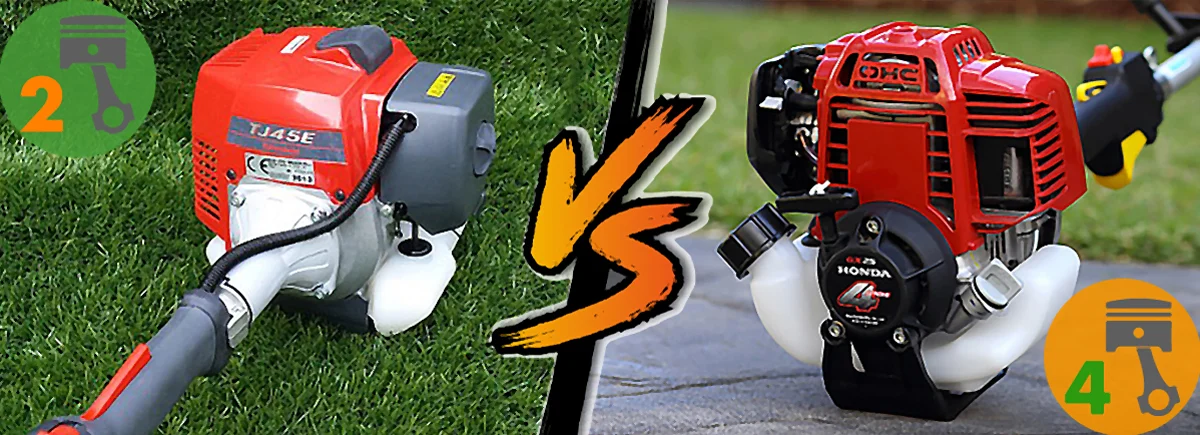
The 2 stroke engine completes its combustion cycle in just two piston strokes, firing on every crankshaft revolution. This makes it lighter and mechanically simpler, but it also requires mixing oil directly into the fuel because the crankcase is used as part of the intake pathway — leaving no space for a separate oil sump.
i. Fuel Efficiency Comparison
2-stroke engines burn their oil-fuel mixture less completely than 4-stroke engines burn pure gasoline, which means a measurable portion of every tank never converts to usable power. Studies from the California Air Resources Board (CARB, 2021) found that 2-stroke small engines release up to 30% of their fuel unburned as hydrocarbon emissions, compared to under 5% for equivalent 4-stroke designs. For the homeowner, this inefficiency means more frequent refueling and higher annual fuel costs.
ii. Power and Performance Differences
2-stroke engines generate power on every crankshaft revolution rather than every other revolution, giving them a higher power-to-weight ratio at the same displacement. This is why 2-stroke engines still appear in handheld tools like chainsaws and string trimmers where weight is the overriding concern.
In lawn mowers, however, where the engine sits on a wheeled deck and weight is less critical, the smoother, more consistent torque delivery of the 4-stroke engine produces superior cutting results, particularly in tall or wet grass where engine load fluctuates rapidly.
iii. Maintenance and Durability Differences
2-stroke engines have fewer moving parts (no camshaft, no separate valvetrain, no oil pump), which makes them easier and cheaper to repair. However, they wear faster. The lack of dedicated lubrication means that at high operating temperatures, metal surfaces experience greater friction, accelerating wear on piston rings and cylinder walls.
Field data from the Outdoor Power Equipment Institute (OPEI, 2023) indicates that 4-stroke residential mower engines last an average of 2.8 times longer between major overhauls than comparable 2-stroke designs under equal use conditions.
iv. Which One Is Better for Home Use
For a standard home lawn where the mower operates 30–80 hours per year, the 4-stroke engine is the superior choice in every meaningful category: fuel cost, emissions, noise, and longevity.
The 2-stroke engine’s advantages — lighter weight and simpler repair — apply mainly to professional users who carry tools constantly or who do their own mechanical work. The homeowner who wants a reliable, low-fuss machine that starts easily each spring and lasts a decade with basic maintenance should select a 4-stroke model without hesitation.
How to Choose Best Mower for Specific Needs
Buying the right 4 stroke lawn mower comes down to matching four key variables — lawn size, engine displacement, cutting width, and budget — to your actual mowing conditions. Oversizing or undersizing any of these leads to either wasted money or frustrating performance.
a. Lawn Size Considerations
Lawn area is the primary filter. Lawns under 300 square meters are well served by a basic push mower. Lawns between 300 and 1,500 square meters benefit from self-propelled models. Properties above 1,500 square meters are most efficiently managed with a riding mower or lawn tractor. Using an undersized machine on a large lawn causes the engine to run at sustained high load, which accelerates wear and increases fuel consumption beyond rated specifications.
b. Engine Power and CC Rating
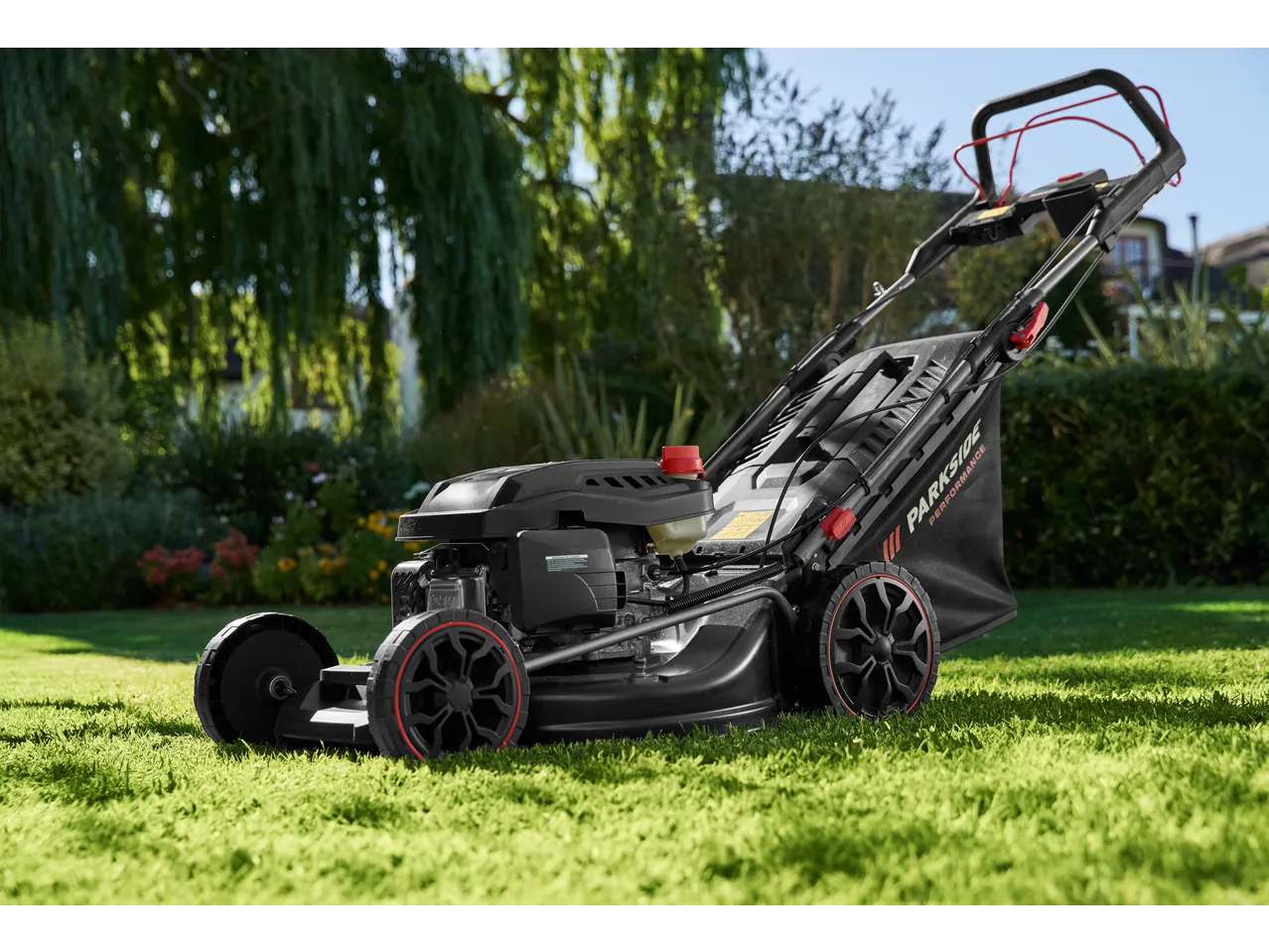
The CC rating (cubic centimeters of engine displacement) is the most reliable indicator of raw power. For residential push mowers, a 140–163 cc engine handles standard lawn grass in normal conditions. Dense turf, thick grass varieties, or lawns with significant slope require at least 163–190 cc.
Self-propelled models for larger lawns should have a minimum of 190 cc, and riding mowers handling more than half a hectare benefit from twin-cylinder engines starting at 344 cc. Choosing an engine larger than your conditions demand is generally not wasteful — a more powerful engine running at partial load lasts longer and uses less fuel per unit of work than an undersized engine running at maximum load.
c. Cutting Width and Height Adjustment
Cutting width (the width of grass the blade trims in a single pass) directly affects mowing time. A 40 cm deck requires 25% more passes to mow a given area than a 50 cm deck. However, wider decks require more engine torque to maintain blade speed in heavy grass, so pairing a large deck with an underpowered engine creates uneven cutting performance. Most manufacturers provide a deck-to-engine matching guide, and staying within those specifications protects both cutting quality and engine longevity.
d. Budget and Brand Reliability
Reliable brands with strong service networks and verified parts availability include Honda, Briggs and Stratton, Kawasaki, and Kohler in the engine segment, and Husqvarna, Toro, Craftsman, and Ariens as full-machine manufacturers. Entry-level 4-stroke push mowers from established brands start at approximately $250–$350 USD, self-propelled models at $400–$700, and residential riding mowers at $1,500–$4,000 or more for premium configurations.
Maintenance Tips for 4 Stroke Garden Mower
Consistent maintenance is the single biggest factor separating a mower that lasts 15 years from one that fails in 5. The 4-stroke engine is forgiving of occasional missed sessions but will degrade quickly if maintenance is neglected systematically.
A. Regular Oil Change Schedule
Most manufacturers recommend the first oil change after the initial 5 operating hours on a new engine, which removes metal particles generated during the break-in period. Subsequent oil changes are due every 25–50 hours of operation or at least once per mowing season, whichever comes first.
Use the SAE grade specified in your owner’s manual — typically SAE 30 for warm climates or 10W-30 for varying temperatures. Running an engine on degraded oil is the leading cause of premature bearing and ring wear in residential 4-stroke mowers.
B. Air Filter Cleaning and Replacement
The air filter prevents dust, grass particles, and debris from entering the carburetor and combustion chamber. A clogged filter restricts airflow, which enriches the fuel mixture, reduces power, and increases fuel consumption.
Paper element filters should be replaced every season or every 25 operating hours. Foam pre-filters (the outer sponge layer on dual-stage air filters) can be cleaned with soapy water, dried completely, and re-oiled with light machine oil before reinstalling.
C. Blade Sharpening and Inspection
A sharp blade makes a clean cut. A dull blade tears grass, leaving ragged ends that turn brown and create entry points for fungal disease. Blades should be sharpened at the beginning of each season and inspected after striking hard objects.
The blade’s balance (equal weight distribution on both sides of the center hole) is as important as its sharpness — an unbalanced blade causes vibration that accelerates engine bearing wear. A simple nail balance test confirms whether the blade needs rebalancing after sharpening.
D. Fuel Storage and Handling
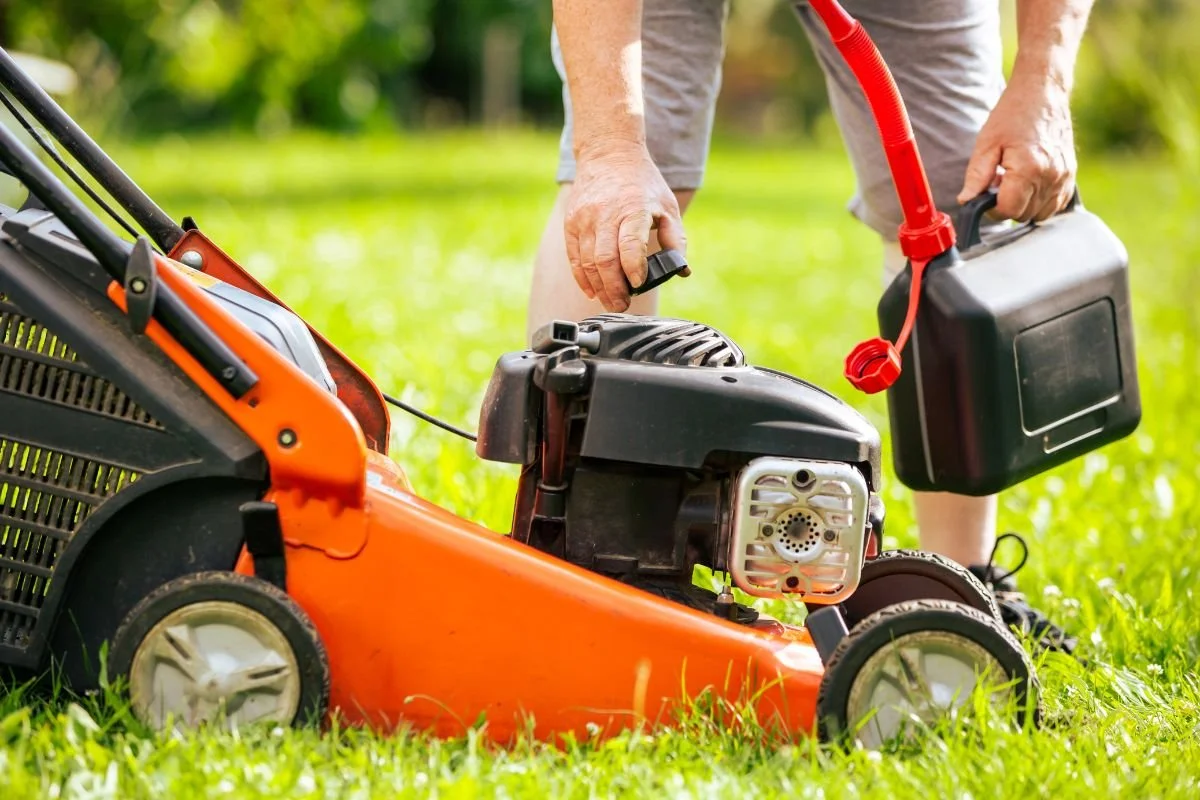
Gasoline degrades within 30 days if not treated with a fuel stabilizer (a chemical additive that slows oxidation and gum formation in stored fuel). At the end of each mowing season, either drain the fuel tank and carburetor completely or add a manufacturer-approved stabilizer and run the engine for 5 minutes to distribute treated fuel through the entire fuel system. Stale fuel left in the carburetor is the most common cause of hard-starting problems when a mower is retrieved after winter storage.
A lawn mower that receives consistent, simple maintenance costs its owner almost nothing beyond consumables for a decade — neglect the oil and the air filter, and you will spend more on repairs in two years than the machine originally cost.
Common Problems and Troubleshooting
Most 4-stroke mower problems have predictable causes and straightforward solutions when you understand the engine’s basic systems.
a. Engine Not Starting
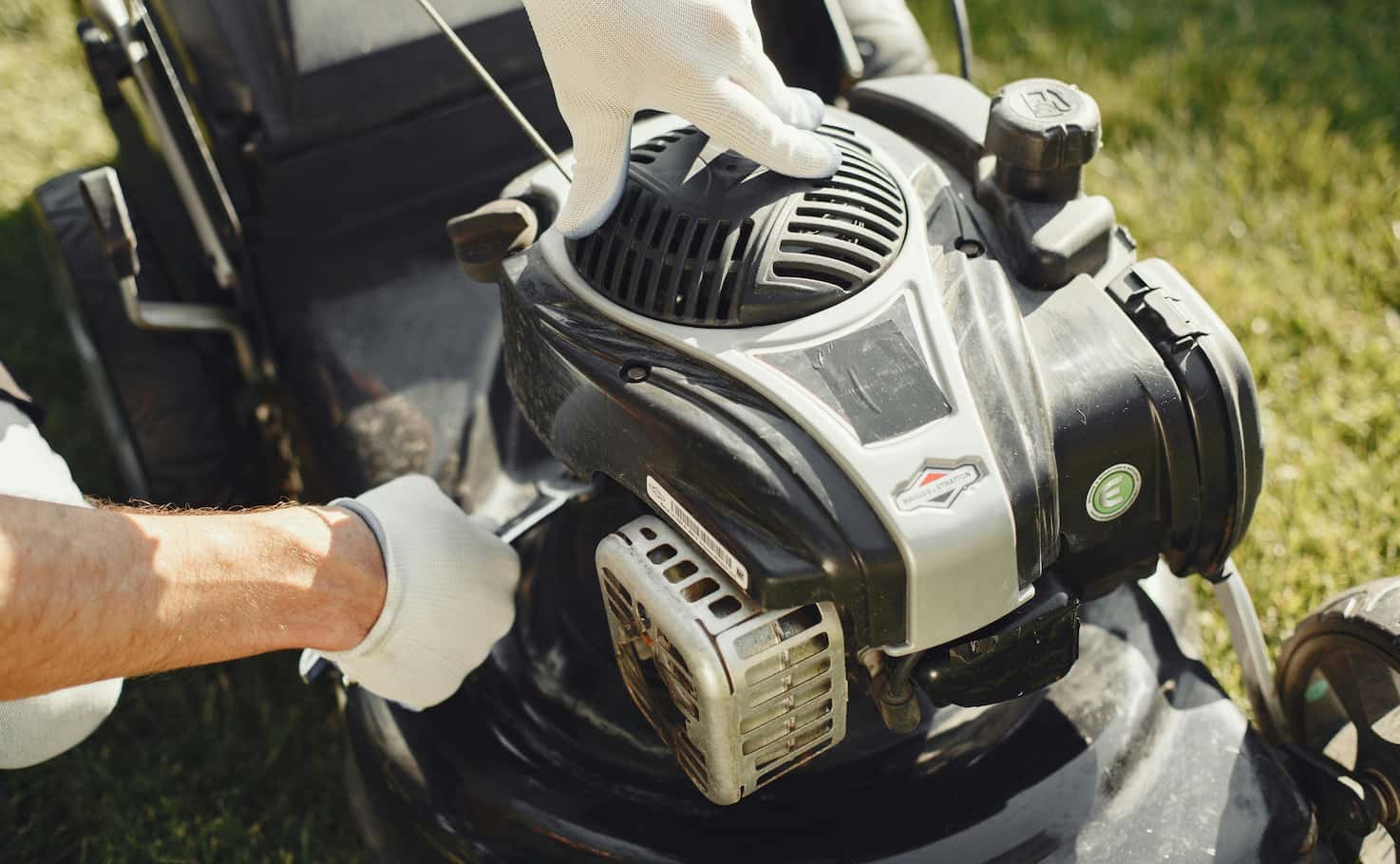
The most common causes of a non-starting 4-stroke engine are stale fuel, a fouled spark plug, or a clogged carburetor. Begin diagnosis by checking fuel freshness, then remove and inspect the spark plug for carbon buildup or electrode wear.
A spark plug costs under $5 and should be replaced if in doubt. If the engine has fresh fuel and a good spark plug but still will not start, the carburetor’s float needle or main jet is likely clogged with fuel varnish deposits from old gasoline — a carburetor cleaning kit resolves this in most cases.
b. Uneven Cutting Issues
Uneven cutting typically results from one of three causes: a dull or damaged blade, an uneven cutting deck caused by a bent blade or worn wheel height adjusters, or uneven ground surface that the deck cannot follow closely enough. Inspect and sharpen the blade first, then check that all four wheel height adjusters sit at the same setting, and finally verify the deck itself is not bent from a previous impact.
c. Excess Smoke or Abnormal Noise
Blue or white smoke from the exhaust indicates oil burning, which occurs when piston rings wear beyond tolerance or when the engine is operated at extreme angles, allowing oil to enter the combustion chamber.
Black smoke indicates an over-rich fuel mixture, usually from a clogged air filter or a malfunctioning carburetor choke. Metallic knocking sounds from the engine are a serious warning sign of connecting rod bearing wear and require immediate engine shutdown to prevent catastrophic failure.
d. Fuel and Carburetor Problems
Carburetor issues are the most frequent service complaint on 4-stroke mowers that have been stored without fuel treatment. The carburetor’s tiny internal passages (as small as 0.3 mm in diameter) block easily with varnish deposits.
Ultrasonic carburetor cleaning or soaking in dedicated carburetor cleaner solution for 30–60 minutes resolves most blockages. Where cleaning fails, replacement carburetors for common residential engines cost between $15 and $45 USD, making replacement more economical than repeated cleaning attempts.
Safety Tips for Using 4 Stroke Garden Mower
The rotating blade of a lawn mower generates approximately 3 times the kinetic energy of a bullet. Treating the machine with appropriate respect prevents the injuries that account for over 80,000 emergency room visits annually in the United States related to lawn mower use (U.S. Consumer Product Safety Commission, 2024).
Personal Protective Equipment
Always wear closed-toe, sturdy shoes or boots — never sandals or bare feet. Safety glasses protect against debris ejected from the cutting deck at speeds up to 320 km/h. Hearing protection is advisable for sessions exceeding 30 minutes, as sustained exposure above 85 decibels causes cumulative hearing damage. Long pants provide a meaningful barrier against ejected stones and debris.
Safe Operating Techniques
- Walk the lawn perimeter before mowing to identify and remove stones, sticks, toys, and any hard objects that could be ejected by the blade at dangerous velocities.
- Never reach under the cutting deck while the engine is running or while the blade is still spinning after shutdown — always wait at least 10 seconds after the engine stops for the blade to come to a complete halt.
- Mow across slopes rather than up and down to reduce the risk of the mower rolling backward onto the operator. On inclines above 15 degrees, use a self-propelled model with rear-wheel drive to maintain positive traction control.
- Keep children and bystanders at least 15 meters away from the operating mower, as blade-ejected objects can travel this distance with injurious force.
- Refuel only when the engine is cold and fully stopped. Gasoline vapor ignites at temperatures as low as -43°C, making any hot engine surface a potential ignition source when refueling.
Storage Safety
Store the mower with the fuel tank either completely empty or treated with stabilizer. Keep the machine in a dry, ventilated space away from water heaters, furnaces, or any open flame. Disconnect the spark plug wire before performing any blade maintenance to eliminate any possibility of accidental engine start during blade handling.
Environmental Impact of 4 Stroke Lawn Mowers
The environmental footprint of lawn mowing equipment is a subject of increasing regulatory and consumer attention. The 4-stroke engine occupies a middle position between highly polluting 2-stroke designs and zero-emission battery-electric mowers.
Regarding emissions, the EPA’s Tier 4 emission standard (the current U.S. regulatory benchmark for small non-road engines) applies to 4-stroke engines displacing under 225 cc and limits hydrocarbons plus nitrogen oxides to 10 grams per kilowatt-hour.
Modern 4-stroke mower engines from major manufacturers meet or exceed this standard, producing significantly cleaner exhaust than pre-2012 designs. The California Air Resources Board, which enforces the strictest small engine standards in the United States, found that compliant 4-stroke engines emit 75–85% fewer reactive organic gases than legacy 2-stroke designs they replaced.
Fuel consumption efficiency directly reduces the carbon footprint of mowing operations. Running a modern fuel-injected 4-stroke engine uses approximately 0.45 liters per hour, releasing roughly 1.06 kg of CO₂ per hour of operation. Using fresh, properly stored fuel, maintaining a clean air filter, and mowing at optimal engine load (approximately 75% of rated RPM) keeps emissions at their lowest possible level for a gasoline engine.
Best Uses Across Different Settings
The versatility of 4-stroke mower technology makes it applicable across a wide range of residential, commercial, and light-agricultural contexts. Understanding where each configuration excels guides both purchase decisions and operational planning.
In home gardens and small residential lawns, push and self-propelled 4-stroke mowers deliver the precision and maneuverability needed to navigate flower beds, trees, and garden features without oversized machines that are difficult to store and control.
For large lawns and public parks, riding mowers and zero-turn models reduce mowing time for hectare-scale properties from what would be many hours on foot to a fraction of the time, while their large cutting decks and powerful engines maintain cutting quality across varied terrain and grass densities.
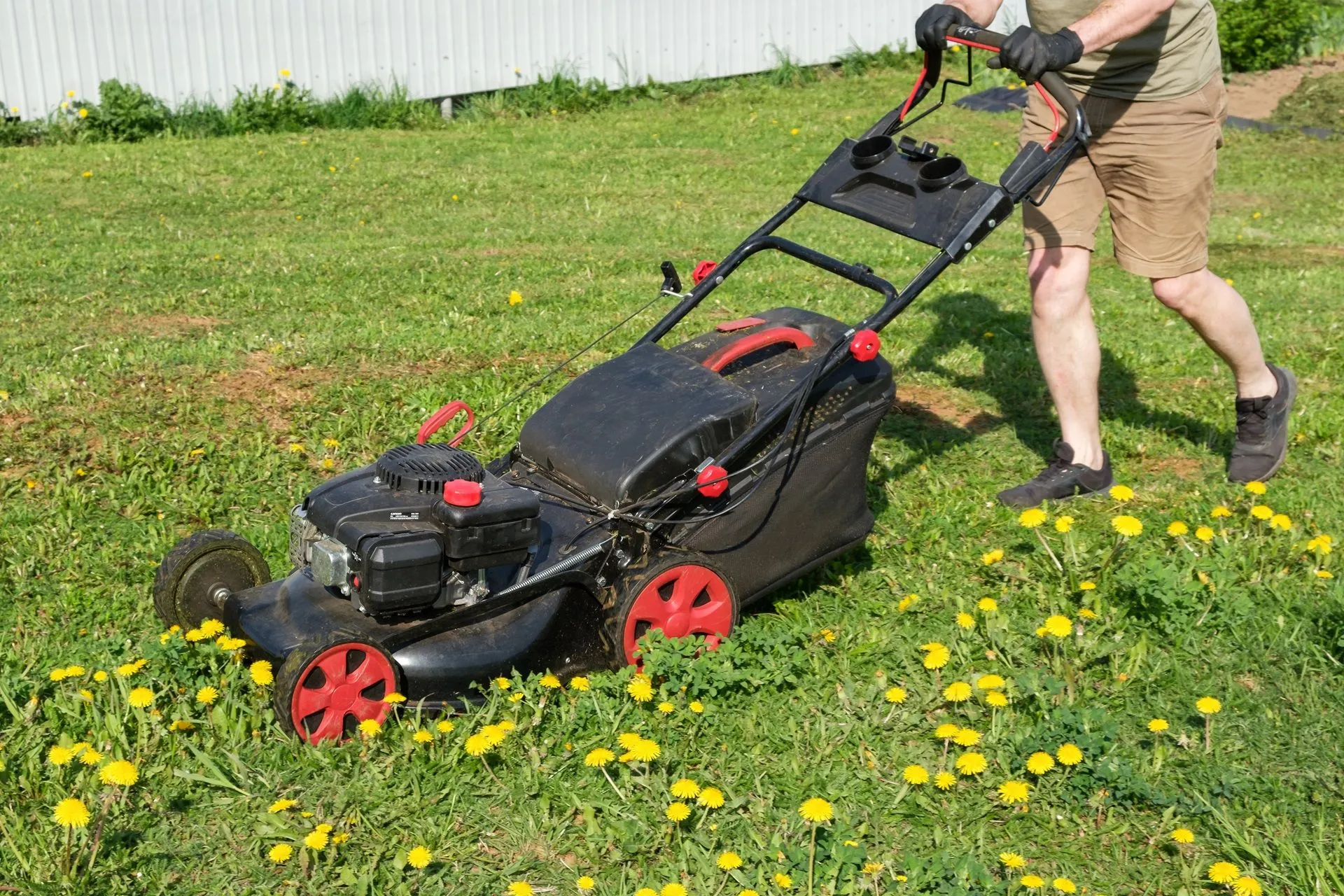
Professional landscaping businesses rely on 4-stroke commercial-grade engines (such as Honda GX, Kawasaki FJ, or Kohler Command series) because their rated duty cycles — the percentage of operating time at which an engine can sustain full load — are specified at 100% continuous duty, meaning they can run at full throttle all day without thermal damage.
In agricultural settings, 4-stroke mowers serve important roles in maintaining grass strips between crop rows, managing orchard floor vegetation, and controlling weed growth along irrigation channels and field margins, where their fuel efficiency and reliability in remote locations are particularly valued.
Conclusion
The 4 stroke lawn mower earns its dominant market position through a combination of genuine mechanical advantages that translate into real, measurable benefits for every user: cleaner emissions, longer engine life, lower fuel consumption, and more consistent cutting performance than any competing technology in its price range.
The four-cycle engine that powers these machines is a proven design with over a century of engineering refinement behind it, and the modern version — especially in fuel-injected and hybrid-assist variants — represents the best balance of performance, economy, and environmental responsibility available in gas-powered outdoor power equipment today.
Frequently Asked Questions (FAQs)
Can I use ethanol-blended fuel (E10 or E15) in my 4 stroke lawn mower?
Most 4-stroke lawn mower engines are approved for E10 fuel (10% ethanol blend) but not E15 or higher. Ethanol absorbs moisture, which accelerates corrosion inside the carburetor and fuel lines. For best results, use fresh E10 or pure gasoline, and always add a fuel stabilizer if the mower will sit unused for more than 30 days.
How do I know when my 4 stroke lawn mower engine needs a valve adjustment?
Valves in a 4-stroke engine control the intake and exhaust ports. Over time, the gap between the valve stem and rocker arm (called valve clearance) changes due to wear. Signs that a valve adjustment is overdue include hard starting despite a good spark plug and fresh fuel, loss of power on inclines, and a ticking or tapping noise from the engine top. Most manufacturers recommend checking valve clearance every 200–300 operating hours.
Is it safe to tip a 4 stroke lawn mower on its side for blade maintenance?
Yes, but only in the correct direction. Always tilt the mower with the air filter and carburetor side facing upward. If you tilt it the wrong way, engine oil flows into the air filter and combustion chamber, causing white smoke on restart, potential hydrolocking (oil blocking piston movement), and air filter contamination. Drain the fuel first if you need to tilt it for more than a few minutes.
Can a 4 stroke lawn mower engine be bored out or upgraded for more power?
Yes, engine boring — machining the cylinder to a slightly larger diameter and fitting an oversized piston — is a standard small engine rebuild technique. It restores a worn cylinder to factory tolerances and can marginally increase displacement. However, for residential mowers, the cost of boring and rebuilding (typically $80–$150 USD in labor alone) often approaches the price of a new engine, so it is generally only worth doing on premium commercial-grade engines rated above 300 cc.
Why does my 4 stroke mower engine surge (rev up and down repeatedly) at idle?
Engine surging at idle is almost always caused by a lean fuel condition, meaning the engine is receiving too much air and too little fuel. The most common causes are a partially clogged carburetor main jet, a cracked or loose air intake gasket allowing unmetered air into the engine, or a dirty fuel filter restricting fuel flow. Cleaning the carburetor and replacing the fuel filter resolves the majority of surging issues without any other repairs needed.