5 Best Wheeled Sprinkler Garden Cart 2026 Buying Tips Guide
- In 2025, the global irrigation equipment market was valued at USD 8.58 billion, underscoring the surge in demand for efficient watering solutions like the Wheeled Sprinkler Cart.
- These portable carts combine mobility with strong coverage, enabling farmers and gardeners to quickly water large areas without fixed systems.
- Typically built from durable steel frames and commercial sprinkler heads, wheeled sprinkler carts bridge the gap between hose-end sprinklers and costly pivots.


A wheeled sprinkler garden cart is a portable irrigation device that mounts one or more sprinkler heads or spray bars on a wheeled frame and connects to a garden hose. It occupies the middle ground between a small hose-end sprinkler and a permanent in-ground system.
An Overview Of 5 Best Wheeled Sprinkler Garden Cart
| Product | Title | Features | Explore |
|---|---|---|---|
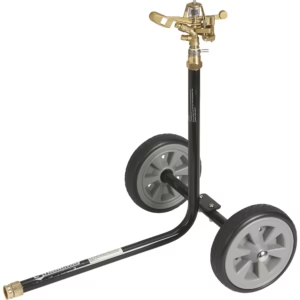 | Strongway Wheeled Sprinkler Cart |
| Check Price |
 | SS1 Stainless Steel Sprinkler Cart |
| Check Price |
 | 1000 ft 1-Inch Wheeled Sprinkler Cart |
| Check Price |
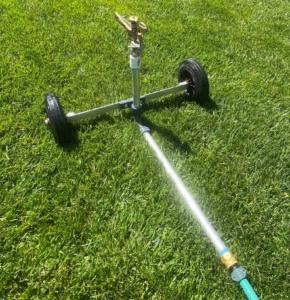 | HoseEndSprinklers Heavy Duty Wheeled Sprinkler Cart |
| Check Price |
 | mel-doom Heavy Duty Wheeled Sprinkler Cart |
| Check Price |
This review examines how these carts are built, how they distribute water, which variables govern their performance, and how they compare with other irrigation methods. It also covers selection criteria for different lawn, garden, and small-farm settings, along with operation, water efficiency, maintenance, storage, troubleshooting, and safety.
The review draws on established principles of irrigation science, including application rate, distribution uniformity, soil infiltration, and hydraulic limits of domestic water supplies. Manufacturer specifications vary widely, so figures below are typical ranges rather than guarantees. Measuring actual output on site is always the more reliable guide.
What Is Wheeled Sprinkler Garden Cart?
A wheeled sprinkler cart removes much of that effort by putting the sprinkler on wheels, so the whole assembly can be pushed, pulled, or in some designs driven by water pressure to the next zone. Watering is a mobility problem as much as a water problem.
A stationary sprinkler covers a fixed footprint, and anything outside it needs a person to carry the device, reconnect the hose, and start again. Gardeners, homeowners, farmers, and landscapers use these carts for different reasons. Homeowners want to water a large lawn without installing underground lines.
Vegetable growers want to reach several beds with one setup. Small-farm operators and landscape crews want a rugged, movable unit that handles newly seeded areas, orchards, or sports turf. In each case the underlying benefit is the same: fewer manual repositioning steps and more consistent coverage per unit of labor.
The main distinction from a stationary sprinkler is the frame. A stationary unit sits on a spike or base and is moved by hand, whereas a cart is designed to be moved repeatedly and, in larger models, over long distances or rough ground. That design difference shapes everything that follows, from component choice to maintenance.
5 Best Top Wheeled Sprinkler Garden Cart For 2026
For 2026, choosing the right wheeled sprinkler garden cart can make lawn and garden watering easier, faster, and more consistent. Here are 5 top options to consider for different garden sizes, coverage needs, and watering conditions.
SS1 Stainless Steel Sprinkler Cart
The SS1 features durable stainless-steel construction, 4–6 mm nozzles, 3–11 GPM flow rates, and adjustable spray patterns. Its GreenPro R3S Max Drive Sprinkler provides full or part-circle coverage, while wheels and brass connections improve practical usability. I found the SS1 easy to reposition, with strong water coverage and adjustable settings that made watering larger areas convenient.
expert start
What is it and its features?
The SS1 Stainless Steel Sprinkler Cart is a portable irrigation cart designed for convenient outdoor watering. It has an all-stainless-steel body and axle, along with a durable brass garden hose connection swivel. The GreenPro R3S Max Drive Sprinkler comes with 4, 5, and 6 mm nozzle sizes, supporting flow rates from 3 to 11 gallons per minute. I also found the adjustable jet stream breaker useful for changing the water stream, while the full or part-circle spray setting helps cover different areas.
Why it Matters?
The SS1 Stainless Steel Sprinkler Cart matters when I need to water a large area without installing a permanent irrigation system. Its wheeled design lets me move it between dry sections, while the adjustable spray pattern helps direct water where it is needed.
The SS1 Stainless Steel Sprinkler Cart also stands out because its stainless-steel construction is designed for long-term outdoor use. I appreciate having different nozzle sizes because they provide more flexibility when water flow and coverage requirements change.
My Set-Up And My Experience
Setting up the SS1 Stainless Steel Sprinkler Cart was straightforward for me. I connected the garden hose to the brass swivel connection, selected the suitable nozzle, and positioned the cart in the area I wanted to water.
The wheels made repositioning simple when I needed to reach another dry section. During use, I liked being able to adjust the spray pattern and jet stream instead of having only one fixed watering direction. The stainless-steel frame also gave me confidence that the cart could handle regular outdoor use.
Performance
The SS1 Stainless Steel Sprinkler Cart performed well when I used it for watering larger outdoor areas. The impact sprinkler produced a strong spray, and the adjustable settings gave me better control over the watering pattern. The choice of 4, 5, and 6 mm nozzles is especially useful because I can match the setup to different water-flow needs.
I also found the wheels helpful because moving the cart was much easier than lifting and carrying a traditional sprinkler. Its ability to cover a large diameter makes it suitable when I need to water more ground with fewer repositioning steps.
Practical Tips
- Choose the nozzle according to your available water flow.
- Position the SS1 Stainless Steel Sprinkler Cart on stable, reasonably level ground.
- Adjust the spray pattern before starting a long watering session.
- Move the cart when the current area has received enough water.
- Rinse the sprinkler and hose connection after heavy outdoor use.
expert end
pro start
| Pros | Cons |
|---|---|
| ✔️ Durable stainless-steel construction | ❌ May be heavier than plastic carts |
| ✔️ Multiple nozzle sizes | ❌ Requires hose and suitable water flow |
| ✔️ Adjustable spray pattern | ❌ Not ideal for very small watering areas |
| ✔️ Easy to move with wheels | ❌ Needs repositioning for separate areas |
| ✔️ Brass hose connection swivel | ❌ Metal construction can increase overall weight |
pro end
Strongway Wheeled Sprinkler Garden Cart
The Strongway Wheeled Sprinkler covers up to 7,800 square feet with its 100-foot diameter brass impact head and two nozzles. Its 8-inch poly wheels, steel frame, 6–10 GPM flow, and adjustable 360-degree or partial spray provide versatile watering control. I found the Strongway Wheeled Sprinkler easy to move, simple to adjust, and effective for watering large lawn areas evenly.
expert start
What is it and its features?
The Strongway Wheeled Sprinkler is a mobile lawn and garden sprinkler designed for wide-area watering. It has a heavy-gauge 3/4-inch powder-coated steel frame, two 8-inch poly wheels, and a 1-inch solid steel axle.
Its brass impact head has two nozzles and can provide up to a 100-foot diameter of coverage. It works at 6 to 10 GPM and 25 to 80 PSI, while the full-circle or partial-arc adjustment gives better control over where the water goes.
Why it Matters?
The Strongway Wheeled Sprinkler matters when you need to water a large area without repeatedly carrying a sprinkler around. Its 100-foot diameter coverage can handle a sizeable lawn, while the two wheels make repositioning easier. I found this combination especially useful for larger open spaces.
Another useful feature of the Strongway Wheeled Sprinkler is its adjustable spray pattern. I could use the full-circle setting for open areas or a partial arc when watering near paths and other areas. The brass head and steel frame also give the sprinkler a sturdy feel during regular garden use.
My Set-Up And My Experience
I connected the Strongway Wheeled Sprinkler to a standard garden hose using its 3/4-inch brass swivel fitting and positioned it on the lawn. The 8-inch wheels made moving it between watering areas fairly simple.
I started with a partial spray pattern and adjusted it according to the area I wanted to cover. Once positioned correctly, the sprinkler provided a broad and consistent spray pattern. The wheeled frame was particularly convenient because I did not have to lift the whole unit every time I wanted to change its position.
Performance
The Strongway Wheeled Sprinkler performed well when watering a large lawn area. Its impact-style brass head produced a strong spray, while the two nozzles helped provide wide coverage.
The 23-degree trajectory helped send water across the lawn rather than keeping the spray close to the sprinkler. I also liked being able to change between a full 360-degree pattern and a partial arc. The wheels rolled smoothly across the lawn, making the unit easier to reposition when one area was finished.
Practical Tips
- Check your water pressure before using it for maximum coverage.
- Use the partial-arc setting near paths, buildings, or garden beds.
- Keep the brass sprinkler head clean for consistent water flow.
- Move the sprinkler between zones instead of overwatering one area.
- Check the hose connection for leaks before starting a watering session.
expert end
pro start
| Pros | Cons |
|---|---|
| ✔️ Wide 100-foot diameter coverage | ❌ Requires adequate water pressure |
| ✔️ Durable brass impact head | ❌ Large coverage may not suit small beds |
| ✔️ Easy-to-move 8-inch wheels | ❌ Heavier than basic plastic sprinklers |
| ✔️ Full or partial spray adjustment | ❌ No written warranty listed |
| ✔️ Strong steel frame construction | ❌ Uses more water at higher flow rates |
pro end
1000ft 1-Inch Wheeled Sprinkler Cart
The 1-Inch Wheeled Sprinkler Cart features heavy-duty steel construction, a commercial impact sprinkler, 120-foot coverage, and five nozzle sizes. Its 1-inch steel pipe, 1,5-inch steel axle, brass hose swivel, and adjustable spray pattern support reliable large-area watering. In my experience, the wheeled design made repositioning easier, while adjustable water flow helped me manage different watering areas.
expert start
What Is It and Its Features?
The 1-Inch Wheeled Sprinkler Cart is a heavy-duty mobile irrigation cart designed for watering large outdoor spaces. It has a 1-inch steel pipe, a strong 1.5-inch steel axle, and weighs about 25 pounds.
The cart includes a 3/4-inch brass garden hose swivel for hose connection and a commercial-grade impact sprinkler head. Its sprinkler can cover an area up to 120 feet in diameter, while five nozzle sizes allow the water flow to be adjusted for different watering needs.
Why It Matters?
The 1-Inch Wheeled Sprinkler Cart matters because watering a large area by hand can take a lot of time and effort. Its wheeled design makes positioning easier, while the wide spray coverage helps distribute water across lawns, gardens, and other outdoor spaces more efficiently.
Another useful feature of the 1-Inch Wheeled Sprinkler Cart is its adjustable water flow and spray pattern. I found this helpful when watering areas with different requirements. The strong steel construction also gives the cart a stable feel during regular outdoor watering tasks.
My Set-Up And My Experience
Setting up the 1-Inch Wheeled Sprinkler Cart was straightforward. I connected my garden hose to the brass swivel and selected a nozzle according to the watering area. I found the cart easy to move across the yard, and the solid construction gave me confidence while repositioning it. The adjustable impact sprinkler was also useful when I needed to change the spray direction or coverage.
Performance
The 1-Inch Wheeled Sprinkler Cart performed well when I used it for wider watering areas. The impact sprinkler produced a broad spray pattern, and the available nozzle sizes gave me more control over water flow.
I especially liked not having to carry the sprinkler between locations. The sturdy steel pipe and axle made the cart feel durable, while the wheels helped me move it around the yard with reasonable effort. For large lawns and gardens, its wide coverage can reduce the number of times the sprinkler needs to be repositioned.
Practical Tips
- Choose the nozzle size according to your required water flow.
- Place the cart on a reasonably level surface before watering.
- Check the hose connection before turning on the water.
- Adjust the sprinkler pattern to avoid unnecessary water waste.
- Clean the sprinkler head and nozzles regularly to maintain good performance.
expert end
pro start
| Pros | Cons |
|---|---|
| ✔️ Heavy-duty steel construction | ❌ 25-pound weight may feel heavy for some users |
| ✔️ Covers areas up to 120 feet in diameter | ❌ Better suited to larger watering areas |
| ✔️ Five nozzle sizes for water-flow control | ❌ Requires a hose connection |
| ✔️ Adjustable commercial-grade impact sprinkler | ❌ Steel construction may need care against rust |
| ✔️ Wheels make repositioning easier | ❌ May be more than needed for small gardens |
pro end
HoseEndSprinklers Heavy Duty Wheeled Sprinkler Cart
Brass impact sprinkler provides 58-foot coverage, while steel and aluminum construction offers durability for regular garden watering and outdoor use. Its wheeled design makes repositioning easier, helping cover larger lawns, vegetable gardens, and planting areas without carrying the sprinkler manually. In my experience, the cart felt stable and convenient to move, making routine watering easier across different sections of my garden.
expert start
What Is It and Its Features?
Why It Matters?
The Heavy Duty Wheeled Sprinkler Cart matters when you need to water a larger area without constantly moving a handheld hose or sprinkler. Its 58-foot coverage allows water to reach a wide section, while the wheeled frame makes repositioning simple. This saves effort during routine garden watering tasks.
I also liked the durable material combination of the Heavy Duty Wheeled Sprinkler Cart. Brass provides a solid sprinkler component, while steel and aluminum support the overall structure. During use, the cart felt more suitable for repeated outdoor watering than lightweight plastic sprinkler equipment.
My Set-Up And My Experience
Setting up the Heavy Duty Wheeled Sprinkler Cart was straightforward. I connected the garden hose to the sprinkler cart, placed it on a suitable level area, and positioned the sprinkler toward the section I wanted to water. I usually started with the cart closer to the center of the area so the water could spread more evenly.
The wheels were helpful when I needed to move the cart between different sections of the garden. I also checked the hose connection before turning on the water to make sure there were no unnecessary leaks. During my experience, the cart felt stable during operation, and I appreciated not having to carry the sprinkler around while watering.
Performance
The Heavy Duty Wheeled Sprinkler Cart performed well for general lawn and garden watering. The brass impact sprinkler produced a wide spray pattern, and the claimed 58-foot coverage was useful when watering open areas. I found the wheeled design especially practical because moving the sprinkler required much less effort than dragging a small sprinkler around by hand.
The cart worked best on relatively open and level ground where the spray could reach plants without being blocked by walls, trees, or garden structures. Its metal construction also gave it a more substantial feel during regular use. For routine watering, I found it useful for reducing the time and physical effort needed to cover a larger garden space.
Practical Tips
- Place the Heavy Duty Wheeled Sprinkler Cart on level ground for better stability.
- Check the hose connection before starting the water.
- Position the cart where the spray can cover the widest area.
- Move the cart between sections instead of overwatering one spot.
- Clean the sprinkler after use to help maintain smooth operation.
expert end
pro start
| Pros | Cons |
|---|---|
| ✔️ Wide 58-foot coverage | ❌ Needs open space for best coverage |
| ✔️ Durable brass impact sprinkler | ❌ Less convenient on uneven ground |
| ✔️ Strong steel construction | ❌ Metal construction can feel heavier |
| ✔️ Wheels make repositioning easier | ❌ Requires a connected garden hose |
| ✔️ Suitable for larger garden areas | ❌ Spray can be affected by obstacles |
mel-doom Heavy Duty Wheeled Sprinkler Cart
Covers up to 17,000 sq ft with 22–70 PSI pressure, 23–63 GPM flow, and a durable aluminum sprinkler head. Features a sturdy steel frame, brass union, and large wheels for reliable performance and easier repositioning across large outdoor areas. In my experience, the Heavy Duty Wheeled Sprinkler Cart was easy to set up, move, and use for larger watering areas.
expert start
What is it and its features?
The Heavy Duty Wheeled Sprinkler Cart is a portable irrigation tool that combines a rolling steel frame with a powerful sprinkler head. It can cover up to 17,000 square feet and supports 22–70 PSI pressure with a 23–63 GPM flow range. The aluminum head, brass union, durable wheels, and sturdy frame are built for regular outdoor watering.
Why it Matters?
The Heavy Duty Wheeled Sprinkler Cart matters when a normal garden sprinkler cannot cover a large area efficiently. Its wide coverage reduces the need to move the sprinkler repeatedly, while the strong water flow helps distribute water across lawns, gardens, and other large outdoor spaces.
The Heavy Duty Wheeled Sprinkler Cart also makes repositioning easier because its large wheels allow smooth movement across suitable ground. I liked this feature when watering different sections because I could roll the unit into place instead of carrying a heavy sprinkler.
My Set-Up And My Experience
I set up the Heavy Duty Wheeled Sprinkler Cart by connecting my water hose to the brass union and positioning the cart where I wanted to begin watering. The setup was straightforward, and the wheels made positioning much easier. During use, I appreciated the stable steel frame and wide watering reach.
Performance
The Heavy Duty Wheeled Sprinkler Cart performed well when I used it for larger watering areas. The aluminum sprinkler head produced a strong spray, while the available pressure and flow range provided good coverage. I found the cart particularly useful for reducing manual watering time. Its large wheels also made moving between sections more convenient.
On a large lawn or garden, the wide coverage can save considerable effort compared with repeatedly moving a small stationary sprinkler. The steel frame gave the unit a solid feel during operation, and the brass connection added confidence when attaching the hose.
Practical Tips
- Place the Heavy Duty Wheeled Sprinkler Cart on stable, reasonably level ground.
- Check your water pressure before expecting maximum coverage.
- Connect the hose firmly to prevent leaks around the brass union.
- Move the cart between sections instead of stretching the hose too far.
- Clean the sprinkler head regularly to maintain an even spray pattern.
expert end
pro start
| Pros | Cons |
|---|---|
| ✔️Large coverage up to 17,000 sq ft | ❌Maximum coverage needs suitable water pressure |
| ✔️Strong steel frame | ❌May be larger than needed for small gardens |
| ✔️Durable aluminum sprinkler head | ❌Requires regular sprinkler-head cleaning |
| ✔️Large wheels make repositioning easier | ❌Rolling is less convenient on very rough ground |
| ✔️Brass union provides a sturdy hose connection | ❌High water flow may increase water consumption |
Basic Design and Construction
Most wheeled sprinkler carts share a common set of parts. A frame, usually steel, aluminum, or reinforced polymer, carries the load and holds the sprinkler assembly at a fixed height above the ground. Wheels connect the frame to the ground, and a handle or tow hitch provides the means of movement. A water inlet accepts a standard garden hose, and internal plumbing routes water to the distribution mechanism.
The distribution mechanism is where designs diverge most. Some carts use a rotating impact or gear-driven sprinkler head that throws water in a circle or arc. Others use a horizontal spray bar with multiple nozzles, which produces a rectangular or band-shaped pattern. Rotating arms are also common. Each approach produces a different droplet size, throw distance, and application pattern, and these differences matter for both coverage and soil impact.
Typical coverage ranges from a few hundred square feet for compact garden carts to several thousand for models with large-radius heads operating at adequate pressure. Carts may be manual, requiring the user to move them, or self-propelled, using water-powered drive mechanisms that advance the unit along a path.
Operating Principles Of Wheeled Sprinkler Garden Cart
Operation begins with the hose connection. Water enters under the pressure supplied by the household spigot or pump, flows through the cart’s plumbing, and exits through nozzles or a rotating head. Pressure at the nozzle determines droplet size and throw distance. Too little pressure shortens the throw and produces large, uneven drops that land close to the unit. Too much pressure atomizes the water into fine mist that drifts in wind and evaporates before reaching the soil.
Movement is handled differently by each type. A manual cart is repositioned by hand after each watering cycle. A tow-behind cart is attached to a lawn tractor or riding mower and relocated without the operator walking the full distance. A self-propelled cart converts part of the water’s energy into forward motion, often through a turbine or piston drive, and advances along the ground or along a laid hose.
Coverage can be adjusted on most models by changing the arc of the head, altering the angle of the spray bar, or raising and lowering the sprinkler. Adjustment is what allows one cart to serve a square lawn, a narrow strip along a fence, and a bed with obstacles without wasting water on pavement.
Main Types of Wheeled Sprinkler Cart
Wheeled sprinkler carts come in several main varieties, each suited for different scales and power sources.
i. Manual wheeled carts are pushed into position and left to run. They are inexpensive, mechanically simple, and well suited to small and medium areas. The limitation is labor: every move is the operator’s job, and the cart stops being convenient when the property is large.
ii. Tow-behind carts attach to a lawn tractor or riding mower and are built for larger properties. A wide track and larger wheels help them stay stable while being pulled. They suit acreage, long lawns, and settings where walking back and forth would waste time. They require a compatible hitch and a plan for water supply, since a long hose is still needed.
iii. Self-propelled carts use water-powered drive systems to move without manual pushing. They can cover long strips of lawn with minimal supervision. Their drive mechanisms need adequate pressure and flow to function, so they depend more heavily on the home’s water supply than manual units do.
iv. Heavy-duty carts feature stronger frames, larger wheels, and higher flow requirements. They serve agricultural and commercial uses where durability and wide coverage outweigh cost and weight.
v. Portable garden carts are lightweight and designed for easy relocation. They fit small lawns and garden beds, and they store easily, though they handle rough terrain and high flows less well than heavier designs.
Main Components & Features Of Wheeled Sprinkler Cart
Several components decide whether a cart performs well in practice.
a. Frame material affects weight, strength, and corrosion resistance. Powder-coated or galvanized steel is strong but heavy and can rust if the coating is damaged. Aluminum resists corrosion and is lighter, while reinforced polymer is rustproof and inexpensive but may flex under heavy loads.
b. Wheel size and number control how a cart behaves on soft or uneven ground. Larger wheels roll over bumps and sod more easily and sink less in soft soil.
Two-wheeled designs are lighter and easier to tilt and push, while four-wheeled designs are more stable on slopes and under towing.
c. Sprinkler heads and spray arms determine the pattern and throw distance.
d. Flow controls let the user regulate how much water reaches the head, and coverage and height adjustments tune the spray to the area.
e. A tow hitch is needed for tractor use, and a comfortable handle matters for manual models that are moved often.
f. Rust-resistant construction in the fasteners, axle, and fittings extends service life in an environment that is wet by design.
Wheeled Sprinkler Cart Coverage Area
Manufacturers rate sprinkler cart coverage by the radius or area that one cart can water per cycle. Typically, a single cart can water up to 0.5 to 2 acres in one location before moving. The exact area depends on nozzle settings and water supply. Coverage is influenced by several factors:
i. Water Pressure (PSI): Higher PSI (pounds per square inch) pushes water farther, increasing radius. A cart might reach 30–40 feet in radius at 40 PSI, whereas at 20 PSI it covers less distance.
ii. Hose Size and Length: A 5/8″ hose delivers a higher flow (GPM) than a thinner hose. Long hoses can drop pressure by 1-2 PSI per 50 feet, reducing reach.
iii. Sprinkler Nozzle Design: Nozzles with finer holes create many droplets (good for gentle rain-like coverage), while coarse nozzles shoot farther but with larger drops. Adjustable nozzles let you trade distance for distribution style.
iv. Wind Conditions: Strong wind can drift spray, shrinking the effective coverage area. Manufacturers’ ranges assume calm conditions. In practice, wind can reduce actual area by 10–20%.
v. Lawn Shape and Obstacles: Actual coverage area will be irregular if trees, fences, or curved boundaries block part of the spray. Multiple overlapping passes may be needed in odd-shaped lawns.
vi. Surface and Slope: Uneven ground or slopes may cause runoff or require more time in one spot. This can limit how much area a cart can effectively water before adjustment.
Water Pressure and Flow Requirements
Two hydraulic quantities govern sprinkler performance. Pressure, measured in pounds per square inch (PSI), is the force that pushes water through the system. Flow, measured in gallons per minute (GPM), is the volume delivered over time. Both must be adequate. A supply with high pressure but low flow, or the reverse, will underperform.
Effective irrigation depends not only on sprinklers but on matching water pressure and flow to your equipment; the right PSI and GPM are just as crucial as the sprinkler design.
Home water pressure commonly falls in a range of roughly 40 to 80 PSI, though local supplies differ. Hose-end sprinklers often work best at moderate pressures, so a cart on a high-pressure supply may benefit from a pressure regulator to prevent misting and stress on fittings.
Residential spigots frequently deliver somewhere around 5 to 10 GPM, but this varies with pipe size, household demand, and distance from the main. A simple bucket-and-timer test at the spigot gives a usable estimate of available flow.
Hose choice affects both. Longer and narrower hoses lose more pressure to friction. A 5/8-inch hose generally carries more flow with less loss than a 1/2-inch hose of the same length, and a 3/4-inch hose does better still. Excess pressure can damage seals and cause leaking at connections, so manufacturer pressure limits should be treated as hard limits.
Best Uses for Wheeled Sprinkler Wheelbarrow
Wheeled sprinkler carts perform best where an area is large enough to make hand-moving small sprinklers tedious but not so large or valuable that a permanent system is justified. Wheeled sprinkler carts excel in many scenarios:
a. Lawn Irrigation: They are ideal for large lawns where a stationary sprinkler might miss corners or require multiple units. Users can water one section, then roll the cart to another, ensuring uniform wetting.
b. Vegetable Gardens: For row crops or scattered beds, a cart can move between rows, providing gentle rainfall-style irrigation that protects delicate plants. Gardeners can wheel the cart down a furrow and back, covering multiple rows.
c. Flower Gardens and Beds: Many ornamental plants prefer light watering. A low-pressure nozzle on the cart can water a flower bed evenly without ponding, covering wide beds that a small sprinkler cannot.
d. Newly Seeded Grass: For seeds to germinate, frequent light watering is needed. A cart can be moved often on a low-arc setting, preventing the shock of too much water in one spot.
e. Large Yards and Recreational Areas: Sports fields, playgrounds, or golf course roughs often use wheeled carts or traveling sprinklers for quick coverage of flat, open grass. They allow crews to water the entire field with one or a few carts without installing permanent in-ground pipes.
f. Orchards: Small orchards or vineyards may use carts during establishment. The cart can be wheeled between tree rows, and raised on step platforms if needed, to water young trees.
g. Small Farms: Farms without full pivot systems sometimes rely on carts for specific areas (like alfalfa fields, pastures, or new fruit tree plantings). Tow-behind or self-propelled carts handle medium field sizes without requiring a full irrigation infrastructure.
h. Agricultural and Commercial Projects: Dust control on farms, construction sites, or arenas can also be done with heavy-duty sprinkler carts moving over dirt tracks. The powerful spray suppresses dust when needed.
i. Landscaping Projects: Landscape contractors often use wheeled carts when watering new sod or seeding in large sites (for example parks or estates) because they avoid digging trenches for pipes.
j. Emergency Watering: In drought or fire seasons, carts provide portable firefighting sprays or stand-alone backup irrigation if pumps fail. They can be quickly deployed around structures or vulnerable crops.
Comparison With Other Irrigation Methods
No irrigation method is universally best. Each trades off mobility, coverage, setup effort, water use, cost, and maintenance.
Against an oscillating sprinkler, a cart typically offers easier relocation across larger areas and, in some designs, wider reach. An oscillating unit is cheaper, simpler, and gives a predictable rectangular pattern on small lawns.
Against a traveling sprinkler, which follows a laid hose, a cart usually gives the operator more control over position and pattern, while a traveling unit offers more hands-off coverage along a path. Self-propelled carts blur the line between the two.
Against in-ground irrigation, a cart costs far less to buy and install and can be taken to different properties or moved to different zones.
An in-ground system, however, provides automation, consistent placement, and lower labor, and it can be designed for high uniformity with zoned control.
Against a hose-end sprinkler on a spike or base, a cart adds mobility and sometimes durability, but may cost more and take more storage space.
Against an impact sprinkler used alone, a cart integrates the same kind of head with wheels, so the choice is mostly about handling versus portability.
Against any stationary sprinkler, the cart’s advantage is repeated repositioning with less labor.
Selection Criteria
Choosing a cart begins with the property. Lawn or garden size sets the required coverage, and water pressure and flow set what the supply can actually support. A cart rated for large coverage but fed by a weak spigot will deliver disappointing results.
Build quality matters just as much. Wheel quality and frame durability determine whether the cart survives repeated movement over turf, gravel, and mud. Sprinkler adjustment range determines how well the cart adapts to irregular areas. Hose compatibility, usually standard garden hose threading, avoids adapters that leak.
Portability and storage requirements matter for owners with limited space. Terrain, budget, and the availability of replacement parts finish the list. A cheap cart with unavailable parts becomes a disposable item the first time a nozzle or seal fails.
Cart Choice by Lawn Size
Small lawns are well served by compact carts with lower water requirements. Their lighter frames are easier to push and store, and the smaller coverage area matches the limited footprint.
Medium lawns benefit from wider spray coverage and more adjustable systems. A cart that can shift between an arc and a full circle, or between a narrow and a wide pattern, adapts to lawns with several distinct sections.
Large lawns call for traveling or tow-behind models, with larger wheels and stronger frames. At this scale, the time saved by not walking each move becomes meaningful, and the demand on the water supply grows with it.
Use on Farms and Large Properties
A cart makes sense on a farm or large property when the area is too big for hand sprinklers but does not justify the capital cost of dedicated agricultural irrigation, or when watering is occasional, such as for establishing seedlings or supplementing a dry spell. Orchard rows, small pastures, and test plots are examples.
Coverage, water source, and terrain decide whether the approach is practical. The water supply must deliver sufficient flow over the hose length required, and tow-behind systems need a tractor or utility vehicle and a hose handled with care. Soil conditions affect traction and how quickly water infiltrates.
Carts have clear limits compared with agricultural systems such as center pivots, drip lines, or fixed sprinkler grids. Those systems deliver higher uniformity, automation, and efficiency at scale. A cart is better seen as a flexible, low-capital option than a replacement for engineered irrigation.
Performance on Uneven Ground
Terrain exposes the weak points of a cart. Wheel size determines whether the cart rolls over ruts and roots or digs in. Ground clearance prevents the frame from catching on grass and debris. Stability matters on slopes, where a top-heavy unit can tip and a heavy one can run away when released.
Mud and soft soil are especially difficult. Wide, large-diameter wheels distribute weight and resist sinking, while small narrow wheels cut ruts and stall. Grass and gravel present different problems: grass offers traction but resistance, while loose gravel can jam wheels.
Lightweight carts can struggle on rough terrain because they lack the mass and wheel size to roll over obstacles, and may bounce, tilt, or shift the spray pattern as they move.
How Long to Run a Cart
Runtime should be set by the water the soil receives rather than by the clock. The target depends on soil type, grass or crop type, weather, season, and the cart’s output. A common rule of thumb for turf is around one inch of water per week, split across one or two sessions, but actual needs rise in hot, dry, or windy conditions and fall in cool or humid ones.
Soil type changes how that water behaves. Sandy soils absorb water quickly but hold little, so they favor shorter, more frequent applications. Clay soils absorb slowly and can generate runoff if water is applied faster than they can infiltrate, so they favor slower applications with rest intervals.
The most reliable method is a catch test. Place several straight-sided containers, such as small cans, at different distances from the cart, run it for a fixed period, and measure the depth of water collected. This reveals both the average application rate and the unevenness of the pattern.
Water Efficiency
Water efficiency with a cart is largely a matter of matching application to need. Overwatering wastes water, promotes shallow roots and disease, and leaches nutrients. Watering early in the day reduces evaporation and wind drift, and lets foliage dry before evening. Matching runtime to soil conditions prevents runoff, which appears as pooling or water running toward drains.
Spray adjustment saves water by keeping it off sidewalks, driveways, and fences. Where compatible, a hose-end timer prevents a cart from running far longer than intended. These practices do not depend on the cart model, but a cart with good adjustability makes them easier to apply.
Wheeled Sprinkler Cart Maintenance
Regular maintenance prevents breakdowns during a crucial watering moment. For example, a clogged nozzle might cause uneven watering; catching that beforehand avoids a patchy lawn. Proper maintenance extends the life and performance of a sprinkler cart:
i. Clean Nozzles and Heads: After use, flush debris from sprinkler heads. Mineral buildup or dirt can clog nozzles. Disassemble periodically and soak nozzles in vinegar if mineral scale forms.
ii. Check Hose Connections: Ensure O-rings and gaskets at the inlet are intact. Replace washers or connectors if leaks are detected.
iii. Inspect Wheels: Check tire pressure (for pneumatic tires) and remove stones from treads. Lubricate wheel axles annually for smooth operation.
iv. Lubricate Moving Parts: Apply a light oil to any gears or the water turbine (if accessible) in self-propelled models. Also lubricate the spray arm linkage if present.
v. Frame Inspection: Look for cracks or bent parts, especially after towing over rough fields. Tighten loose bolts or braces.
vi. Spray Arms and Guides: Ensure spray arms rotate freely and aren’t bent. Remove any vegetation wrapped around them.
vii. Prevent Rust: Wipe down metal parts and touch up any paint chips on steel frames. Store indoors if possible.
viii. Alignment: Make sure the sprinkler head is centered on the frame and the axle is straight. A misaligned wheel can cause the cart to veer, affecting coverage.
ix. Test Drive: Occasionally test the cart without water. Self-propelled carts should move smoothly; if crawling or jerking, check the drive mechanism.
x. Hose Care: Don’t let the hose dry and crack on the cart; remove hoses when done. Inspect hoses for leaks or weaknesses, since low water supply could be a problem without realizing it.
xi. Sprinkler Replacement: Sprinkler heads wear over time. Keep spare nozzles and heads. Impact springs and bearings may need occasional replacement in high-use carts.
xii. Seasonal Checks: Before peak season, do a quick test run on each cart. Fix any issues before the busy watering period.
Common Wheeled Sprinkler Wheelbarrow Problems
A cart that does not move usually points to low water pressure, a drive mechanism issue, or an obstruction at the wheels. Checking pressure first, then inspecting the drive and wheels, isolates the cause.
a. Uneven watering typically stems from blocked nozzles, incorrect pressure, or poor positioning. Cleaning nozzles and checking pressure at the cart often resolves it, and a catch test shows where the gaps are.
b. Low water flow is often caused by a kinked hose, a clogged connection, or an inadequate supply. Straightening the hose, cleaning inlet screens, and testing the spigot flow separate cart problems from supply problems.
c. Leaking connections come from damaged washers, loose fittings, or worn connectors. Replacing washers and tightening fittings by hand is usually enough.
d. Wheels getting stuck results from mud, small wheels, debris, or uneven terrain. Moving to firmer ground, clearing debris, or choosing a cart with larger wheels addresses the cause.
Wheeled Sprinkler Cart Safety Considerations
By observing these safety tips, users prevent injuries or equipment loss. Like any machinery, treating the sprinkler cart with care extends life and protects people.
a. Trip Hazards: Lay hoses so they don’t crisscross walking paths. Use hose reels or fasteners if needed. A person can trip on a hose loop or the cart’s frame if not vigilant.
b. Slip Hazards: Wet grass can be slick. Workers should wear non-slip footwear during watering. Clear algae or mud off driveways and sidewalks to avoid falls.
c. Electrical Safety: Never run a cart near buried or overhead electrical lines. Avoid connecting hoses across live electrical areas. If using pumps, ensure they are grounded.
d. Children and Pets: Keep kids and pets away while watering is in progress. Moving equipment and high-pressure spray can injure unsupervised bystanders.
e. Pressure Limits: Do not exceed the manufacturer’s recommended PSI. If the cart’s frame or hose is rated for 80 PSI, going higher risks a burst fitting or cart damage.
f. Slopes: When moving a cart on a slope, secure it if parked. A loose cart can roll downhill, causing collisions. Avoid working on very steep grades.
g. Strain Injuries: When pushing a heavy manual cart, use proper posture (legs push, not back) to avoid strain. Tow heavy loads with vehicles rather than brute force.
h. Secure Tow-Behind: Ensure safety chains and hitch pins are properly secured when towing. A loose cart can detach and cause accidents.
i. Visibility: If watering near roads or paths, use reflective markers or cones. A black metal frame can be a hard-to-see obstacle at dusk.
j. Chemical Safety: If fertigation (fertilizer injection) is used with the cart, follow chemical guidelines. Clean the cart thoroughly after if not using for chemicals next time.
k. Equipment Condition: Regularly inspect braking mechanisms or wheel locks. A malfunction during use can lead to runaway equipment.
Conclusion
A wheeled sprinkler cart is useful because it turns repeated manual repositioning into a quicker, more controlled task. The right type depends on the size of the lawn, garden, or property: compact manual carts for small areas, adjustable carts for medium lawns, and tow-behind or self-propelled models for large ones.
Performance depends on a handful of variables that interact: coverage, water pressure and flow, mobility, durability, and terrain. A cart that suits the land but outruns the water supply will disappoint, and so will a well-supplied cart with small wheels on soft ground.
Frequently Asked Questions (FAQs)
Can you use a wheeled sprinkler cart in a vegetable garden?
Yes, with care. Lower the head, reduce pressure, and position the cart so the spray reaches the beds without soaking foliage excessively.
Can a wheeled sprinkler cart work on uneven ground?
It can, if the cart has large wheels, good clearance, and stable construction. Lightweight carts with small wheels often struggle.
What size hose does a wheeled sprinkler cart need?
A standard garden hose works for most carts. A 5/8-inch or 3/4-inch hose reduces pressure loss over longer distances compared with a 1/2-inch hose.
How much water does a wheeled sprinkler cart use?
Use depends on the model and supply, commonly in the range of several gallons per minute. A catch test and a flow test at the spigot give a reliable figure.
How long should you run a wheeled sprinkler cart?
Run it long enough to deliver the target depth of water for the soil and plants, then check with containers. Sandy soils need shorter cycles than clay soils.
Are wheeled sprinkler carts better than stationary sprinklers?
They are more convenient for larger areas because they reduce manual repositioning, but stationary sprinklers can be cheaper and simpler for small spaces.
How do you store a wheeled sprinkler cart during winter?
Drain all water, disconnect the hose, clean and dry the cart, and store it under cover to prevent freezing damage and rust.
Why is my wheeled sprinkler cart not moving?
Common causes include low water pressure, a drive mechanism problem, or something blocking the wheels. Check pressure first, then inspect the drive and wheels.
references:
1. Briskin, E., Kalinin, Y., Lepetukhin, K., & Maloletov, A. (2020). About controlling the shape of the sprinkler. In Robotics: Industry 4.0 Issues & New Intelligent Control Paradigms (pp. 147-157). Cham: Springer International Publishing.
2. El-Hagarey, M. E., Mehanna, H. M., & Mansour, H. A. A. (2019). Soil Moisture and Salinity Distributions Under Modifi ed Sprinkler Irrigation. In Closed Circuit Trickle Irrigation Design: Theory and Applications (pp. 35-54). Apple Academic Press.
3. Ozaki, Y. (1999). Design of the robotic self-travelling sprinkler system. Cranfield University (United Kingdom).
4. Zhuravleva, L. A., & Popkov, I. A. (2022, January). Improving the patency of sprinkler machines on moistened soil on the basis of experimental and theoretical studies of the system “irrigation rate-soil-sprinkler machine”. In IOP Conference Series: Earth and Environmental Science (Vol. 949, No. 1, p. 012003). IOP Publishing.